Introduction
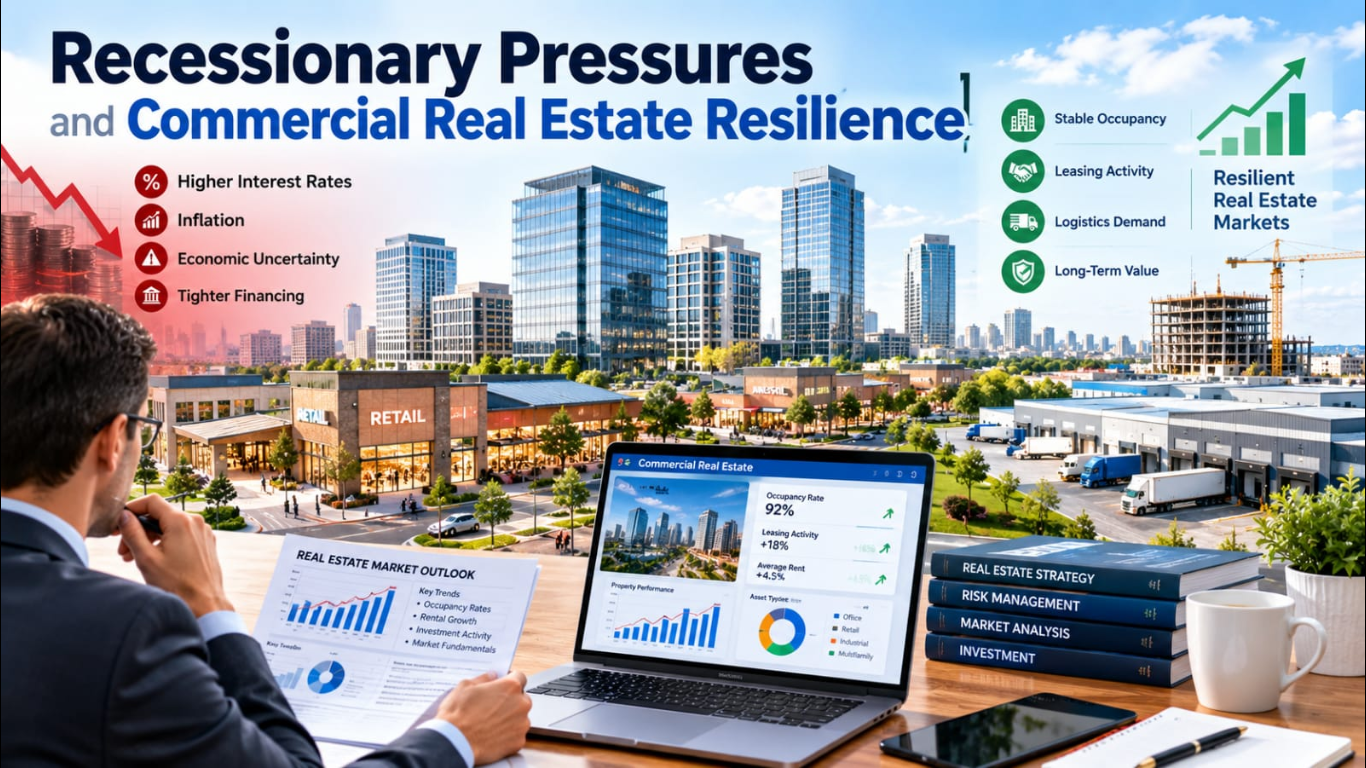
Commercial real estate (CRE) operates closely alongside the wider economy. When economic growth slows, businesses become more cautious, financing can become expensive, and property demand may weaken. These conditions create recessionary pressures and commercial real estate resilience, a combination that is increasingly important for investors, developers, landlords, lenders, and occupiers.
In 2026, the U.S. commercial real estate market is facing elevated interest rates, inflation concerns, geopolitical uncertainty, and uneven demand across property sectors. Yet current market evidence also shows several sources of resilience. CBRE’s midyear outlook says U.S. CRE investment activity remains on track for a 16% year-over-year increase, while income growth and improving property fundamentals are supporting the market.
Understanding Recessionary Pressures in Commercial Real Estate
A recession can affect commercial property through several channels. Slower economic activity can reduce corporate expansion, weaken consumer spending, and cause businesses to postpone leasing decisions.
Financing is another major pressure point. Higher benchmark interest rates increase the cost of acquiring, refinancing, and developing properties. Properties with substantial debt exposure can therefore face greater financial pressure when loans mature.
Vacancy can also become a concern. If businesses reduce their space requirements, landlords may experience longer leasing periods, higher concessions, or declining rental income.
However, the effect of a downturn is rarely uniform. Different property types, locations, tenants, and buildings can experience very different conditions.
Why Commercial Real Estate Can Remain Resilient
Commercial real estate resilience often comes from the diversity of the property market. Office buildings, industrial facilities, retail centers, multifamily properties, healthcare assets, and data centers respond differently to economic changes.
CBRE’s 2026 outlook highlights structural sources of demand including artificial-intelligence infrastructure, manufacturing reshoring, healthcare-related demographic trends, and limited housing affordability. These drivers can support particular real estate segments even when broader economic conditions become more challenging.
Supply conditions can also strengthen resilience. When new construction is limited, existing high-quality properties may face less competition from newly delivered space.
Interest Rates and Property Valuations
Interest rates remain one of the most important variables for CRE.
Higher rates can increase borrowing costs and influence capitalization rates, which affect how investors value income-producing properties. CBRE’s midyear 2026 outlook expects cap rates to remain relatively stable through the remainder of the year because benchmark rates have stayed higher than previously anticipated.
This environment places greater importance on property income. Instead of relying primarily on valuation increases, investors may need to pay closer attention to rent growth, occupancy, operating efficiency, tenant quality, and sustainable cash flow.
Office Real Estate Shows Uneven Recovery
The office sector illustrates why commercial real estate resilience should not be treated as a single market-wide trend.
Demand differs substantially between prime buildings and older or less competitive properties. High-quality buildings in locations attractive to major employers can benefit from companies seeking productive, well-located workplaces.
CBRE’s 2026 midyear research reports that office fundamentals are continuing to normalize, while demolitions and conversions are exceeding new completions for a second consecutive year. It also reports stronger demand for prime space and continued long-term commitments from technology companies.
This suggests that property quality, location, building specifications, and tenant demand can matter as much as broader economic conditions.
Industrial and Logistics Properties
Industrial real estate has benefited from long-term changes in supply chains, manufacturing, distribution, and e-commerce.
Reshoring and increased use of third-party logistics providers can create demand for strategically located warehouses and distribution facilities. CBRE expects U.S. industrial leasing activity to improve in 2026, with demand supported by reshoring and outsourcing trends.
Nevertheless, industrial properties are not immune to recessionary pressure. Businesses can reduce inventories, delay expansion, or consolidate facilities during periods of weaker economic activity. Efficient properties with strong locations may therefore have an advantage over obsolete facilities.
Retail Real Estate and Changing Consumer Demand
Retail property performance depends heavily on consumer behavior and tenant strength.
During economic uncertainty, consumers may become more selective about spending. This can affect retailers differently depending on whether they sell essential goods, discretionary products, services, or luxury items.
CBRE’s 2026 outlook identifies grocery, discount, and service-oriented retailers as important sources of physical retail demand. It also notes historically low availability rates in the retail sector.
For landlords, tenant mix and location remain important resilience factors. Well-positioned retail centers can benefit when their tenants provide services consumers continue to use during changing economic conditions.
Multifamily and Housing-Related Demand
Multifamily real estate can have a different economic profile because housing remains an essential need.
However, supply matters. Large numbers of newly completed apartments can temporarily increase vacancy and competition in particular markets. CBRE expects positive multifamily demand during 2026 but notes that some markets still have substantial newly delivered units that remain unleased.
This demonstrates an important principle: even a property sector with strong underlying demand can experience short-term pressure when supply expands rapidly.
The Importance of Strong Property Fundamentals
During uncertain economic periods, investors increasingly focus on fundamentals rather than relying solely on market-wide appreciation.
Important considerations include:
- Occupancy and tenant retention
- Lease duration and renewal potential
- Property location
- Building quality
- Operating expenses
- Rental income
- Debt structure
- Upcoming loan maturities
- Local supply and demand
- Tenant financial strength
CBRE’s 2026 capital-markets research emphasizes that income is expected to be an important driver of total returns while benchmark rates remain relatively elevated.
Debt Management Becomes Critical
Debt can amplify both opportunities and risks in commercial real estate.
A property with manageable leverage and predictable income may be better positioned to withstand a difficult economic period than an otherwise similar property carrying substantial refinancing risk.
Borrowers therefore need to monitor loan maturity dates, interest-rate exposure, debt-service requirements, and available refinancing options. Lenders also have an important role in evaluating whether property income can support existing and proposed debt.
The CRE Finance Council’s second-quarter 2026 sentiment survey showed the industry stabilizing after an earlier decline, although interest-rate sentiment remained a significant weakness.
Technology Is Changing Commercial Real Estate
Technology is becoming another source of structural change.
Artificial intelligence is supporting demand for data centers and influencing how businesses think about office space, infrastructure, and workforce requirements. At the same time, technology can help property owners improve energy management, building operations, tenant communication, and maintenance.
CBRE identifies AI infrastructure as one of the structural demand drivers supporting the 2026 CRE market.
Supply Discipline Can Strengthen Resilience
A market with limited new construction can recover differently from one experiencing a large supply pipeline.
When developers remain cautious because financing and construction costs are high, fewer new properties may enter the market. Over time, this can reduce competitive pressure on existing buildings if demand remains stable.
Supply discipline is particularly relevant when evaluating local markets because national averages can hide major differences between cities and submarkets.
What Commercial Real Estate Investors Can Watch
During recessionary periods, investors can monitor several indicators to understand changing conditions:
Economic Growth
GDP growth, employment, consumer spending, and business investment can influence tenant demand.
Interest Rates
Borrowing costs affect both property values and the feasibility of acquisitions, development, and refinancing.
Vacancy and Rents
Changes in occupancy and rental rates provide direct evidence of property-market conditions.
Construction Pipeline
New supply can create pressure when it arrives faster than demand.
Credit Conditions
Loan availability, lending standards, refinancing costs, and debt maturities can influence transaction activity.
Tenant Quality
Properties supported by financially stable tenants may have different risk characteristics from buildings dependent on weaker tenants.
Building Resilience Through Different Economic Cycles
Commercial real estate resilience does not mean that property values or rents will always rise. Instead, resilience can mean that certain assets and markets can continue generating useful income and adapting when economic conditions change.
The 2026 market illustrates this distinction. CBRE expects U.S. CRE investment activity to increase despite elevated uncertainty, while also emphasizing that returns are increasingly dependent on income and asset selection rather than simple cap-rate compression.
For owners, this means operational performance matters. For investors, careful underwriting matters. For developers, disciplined supply planning matters. For lenders, debt quality and repayment capacity matter.
Conclusion
Recessionary pressures and commercial real estate resilience are not opposing concepts. Economic downturns can create significant challenges for property owners and investors, but commercial real estate is a diverse market with different sources of demand and different levels of exposure.
The current 2026 environment demonstrates that higher interest rates, inflation, geopolitical uncertainty, and changing economic expectations can coexist with improving investment activity and resilient demand in selected property sectors.
The key lesson is that resilience is increasingly tied to strong fundamentals: quality assets, sustainable income, sensible leverage, adaptable properties, careful market selection, and durable sources of tenant demand. As economic conditions evolve, these factors can help determine which commercial properties are positioned to withstand pressure and participate in the next stage of the market cycle.
