Introduction
From a childhood near Warrington to 10 Downing Street, discover Andy Burnham’s early life, education, wife, children, political career and latest role in 2026.
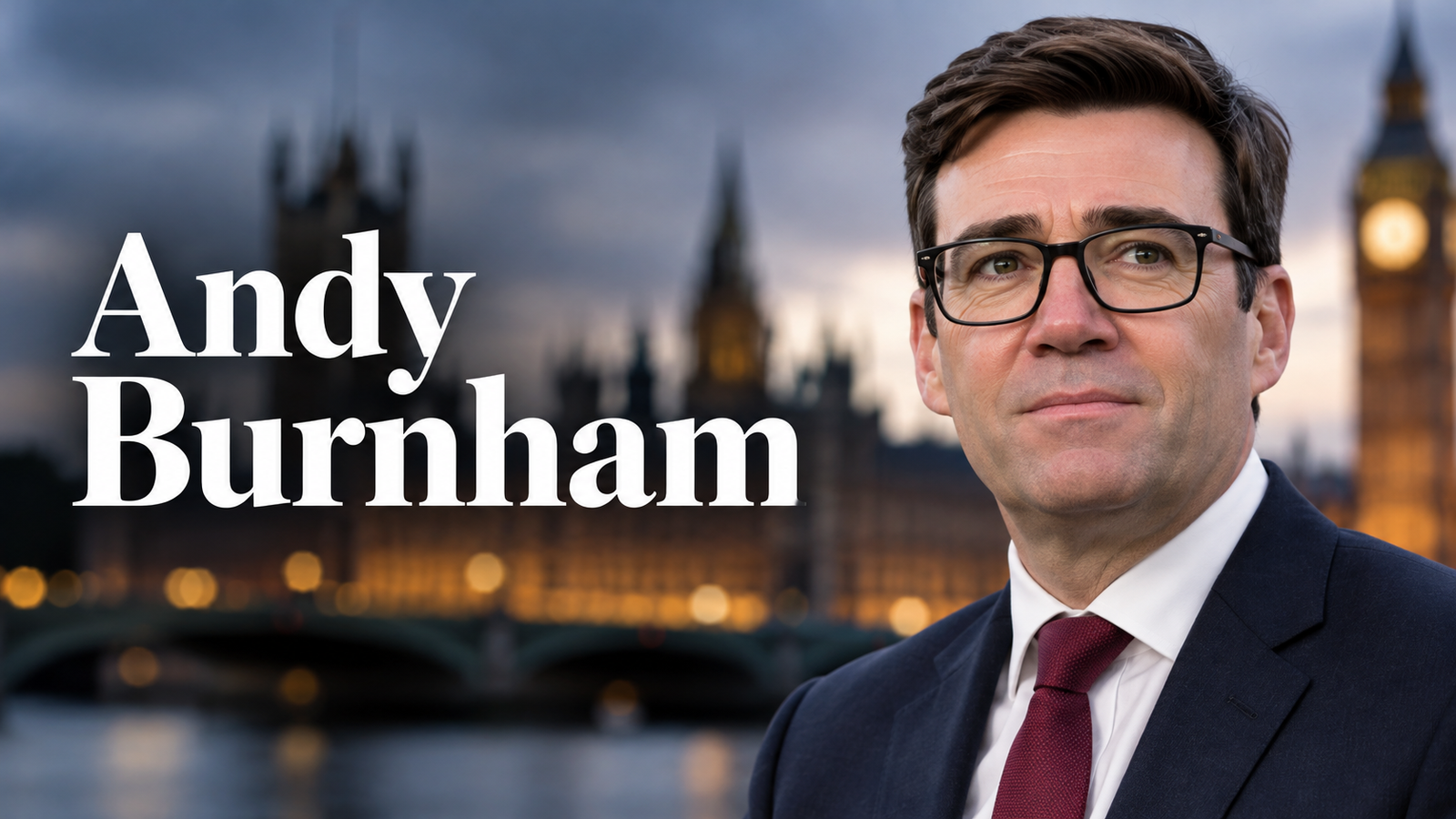
Andy Burnham is a British Labour politician and the Prime Minister of the United Kingdom. He took office on 20 July 2026, following years of work in Parliament and almost a decade as Mayor of Greater Manchester.
His journey was far from straightforward.
He entered Parliament in 2001, became a cabinet minister, lost two Labour leadership contests and later left Westminster to lead Greater Manchester. In 2026, he returned to national politics and became prime minister.
But who is the man behind the political career? Here is his story, from his early years to his family life and work in government.
Quick Facts
| Detail | Information |
|---|---|
| Full name | Andrew Murray Burnham |
| Popular name | Andy Burnham |
| Date of birth | 7 January 1970 |
| Age | 56 years old (2026) |
| Birthplace | Aintree, England |
| Nationality | British |
| Profession | Politician |
| Political party | Labour Party |
| Current role | UK Prime Minister |
| Took office | 20 July 2026 |
| Constituency | Makerfield |
| Former constituency | Leigh |
| Previous role | Mayor of Greater Manchester |
| University | Fitzwilliam College, Cambridge |
| Degree | English |
| Marital status | Married |
| Wife | Marie-France van Heel |
| Children | Three |
| Father | Kenneth Roy Burnham |
| Mother | Eileen Burnham |
| Football club | Everton FC |
| Net worth | Not publicly verified |
Early Life and Family Background
Andy Burnham was born on 7 January 1970 in Aintree, near Liverpool.
He grew up in Culcheth, a village near Warrington in North West England.
His childhood was fairly ordinary.
His father, Kenneth Roy Burnham, worked as a telephone engineer. His mother, Eileen, worked as a receptionist at a GP surgery.
He grew up alongside two brothers.
The family supported Labour, and politics was part of the conversations around him. Burnham joined the party while still a teenager.
Football was another big interest.
He supported Everton from a young age and followed the sport closely. Music also mattered to him. Bands such as The Smiths and The Stone Roses were part of his teenage years.
These interests stayed with him.
His upbringing in the North West later became a frequent subject in his speeches about regional differences, local services and economic opportunity.
Education and University Years
Burnham attended local Catholic schools, including St Aelred’s Roman Catholic High School.
He later secured a place at Fitzwilliam College, Cambridge, where he studied English.
This was a major change.
He had grown up in a northern community and was now studying at one of Britain’s oldest universities.
Burnham has spoken publicly about feeling out of place during his time at Cambridge.
Still, he completed his studies.
He graduated with an upper second-class degree, commonly known as a 2:1.
His university years also brought an important personal connection. He met Marie-France van Heel, who later became his wife.
Before entering professional politics, he had already developed interests in writing, public affairs and sport.
How His Political Career Began
Burnham did not become a politician overnight.
He first worked behind the scenes.
In 1994, he began working as a researcher for Labour politician Tessa Jowell.
This gave him experience in parliamentary work.
He later joined the NHS Confederation, gaining knowledge of healthcare policy and how public services operated.
Football administration also became part of his career when he worked with the Football Task Force.
In 1998, he became a special adviser to Chris Smith, who was serving as Culture Secretary.
These jobs helped him understand government before he entered the House of Commons.
His first major electoral success came in 2001.
Becoming an MP in 2001
Burnham was elected Member of Parliament for Leigh in the 2001 general election.
He was 31 years old.
For the first time, he could represent a constituency directly in Westminster rather than working behind the scenes.
His early parliamentary work included healthcare matters.
Then came government responsibilities.
In 2005, he became Parliamentary Under-Secretary at the Home Office. A year later, he moved to the Department of Health as a Minister of State.
These appointments gave him experience in national government.
But bigger roles were coming.
Cabinet Career Under Gordon Brown
Burnham held three senior cabinet positions between 2007 and 2010.
Chief Secretary to the Treasury
He became Chief Secretary to the Treasury in June 2007.
The job involved public spending and working with government departments on their budgets.
It was a demanding role, especially as Britain approached the financial crisis of 2008.
Culture Secretary
In January 2008, Burnham became Secretary of State for Culture, Media and Sport.
His responsibilities covered areas such as broadcasting, the arts, sport and cultural institutions.
Football remained especially familiar to him.
Health Secretary
In June 2009, he was appointed Secretary of State for Health.
He remained in the position until May 2010.
During this period, the NHS faced questions about funding, patient care and the future organisation of healthcare services.
His time at the Department of Health became an important part of his public career.
After Labour lost the 2010 general election, he continued serving on the opposition front bench.
Labour Leadership Attempts
Burnham contested the Labour leadership twice before becoming party leader in 2026.
His first attempt came in 2010.
He stood against candidates including Ed Miliband and David Miliband. Ed Miliband won, while Burnham finished fourth.
He tried again in 2015.
This contest followed Labour’s general election defeat and Ed Miliband’s resignation.
Burnham received around 19% of the vote, finishing second behind Jeremy Corbyn.
He remained an active Labour politician.
He subsequently served as Shadow Home Secretary until October 2016.
A year later, he made a different career choice.
He decided to leave Westminster.
Why He Became Mayor of Greater Manchester
In 2017, Burnham stood in Greater Manchester’s first directly elected mayoral election.
He won.
The result gave him 359,352 first-preference votes, representing 63.41% of valid first-preference votes.
His new job covered Greater Manchester’s ten local authority areas.
It also gave him a chance to work more directly on regional policy.
He was re-elected in 2021 and again in 2024.
In the 2024 election, he received 420,749 votes, securing around 63.4% of the valid vote.
He remained mayor until June 2026.
Public Transport and the Bee Network
One of Burnham’s best-known mayoral projects was the Bee Network.
Greater Manchester had long relied on a deregulated bus system in which private operators made many decisions about routes and services.
The Bee Network changed that model.
Bus franchising placed more control over the network in the hands of local public authorities.
The wider programme sought to connect buses, trams, cycling and walking services.
Burnham backed the project as a way to make local travel more connected and affordable.
It became closely associated with his mayoral administration.
Work on Homelessness and Housing
Homelessness was another major concern during his time as mayor.
Burnham supported the A Bed Every Night programme, which provided emergency accommodation and support for people sleeping rough.
The aim was to help people find safer places to stay while addressing problems that could leave them without stable housing.
Housing supply also became part of his work.
In 2024, he announced an ambition to deliver 10,000 new council homes across Greater Manchester by 2028.
That was a policy target, rather than a completed result.
His record on housing and homelessness remained part of the debate about his performance as mayor.
His Connection With Hillsborough
Burnham has a long public connection with the campaign for justice following the Hillsborough disaster.
The tragedy occurred on 15 April 1989 during an FA Cup semi-final between Liverpool and Nottingham Forest.
Ninety-seven Liverpool supporters ultimately lost their lives because of the disaster.
Families and survivors spent decades seeking answers, accountability and corrections to false claims about supporters.
Burnham supported their campaign through his political work.
He publicly called for greater transparency and accountability.
The wider campaign was led over many years by the families, survivors and their supporters.
His involvement became one of the most widely recognised parts of his parliamentary career.
His Return to Westminster in 2026
Burnham’s political career changed again in June 2026.
He left his mayoral position and contested the Makerfield parliamentary by-election.
He won the seat on 18 June.
That brought him back to the House of Commons after nine years away.
A month later, Labour faced another leadership change.
Burnham secured sufficient backing to become the party’s only qualifying leadership candidate.
He was declared Labour leader in July 2026.
Then came the biggest appointment of his career.
Becoming the UK’s Prime Minister
On 20 July 2026, Burnham became Prime Minister of the United Kingdom.
He succeeded Sir Keir Starmer.
After meeting King Charles III at Buckingham Palace, he entered Downing Street and delivered his first speech as prime minister.
He spoke about political responsibility, public services and the need for greater stability.
His government also placed regional decision-making, housing, employment and economic development among its priorities.
This marked a striking political return.
Burnham had left Parliament in 2017 to focus on Greater Manchester. Nine years later, he was leading the national government.
Political Views and Main Policies
Burnham’s political positions have often focused on public services and greater local control.
He has supported giving regions more power over transport and economic decisions.
He has also spoken about strengthening the NHS, improving access to housing and helping people find work.
His experience in Greater Manchester influenced his approach to national government.
As prime minister, he has continued discussing the balance between Westminster and regional authorities.
His government has also pursued closer cooperation with European partners while recognising the result of the 2016 Brexit referendum.
These positions are subject to political disagreement, particularly over the cost of public programmes, the role of the state and Britain’s relationship with the European Union.
Who Is Andy Burnham’s Wife?
Andy Burnham’s wife is Marie-France van Heel.
She was born in the Netherlands and met him at Fitzwilliam College, Cambridge, in 1989.
The couple married in 2000.
Marie-France has spent much of her professional life working in marketing.
Her career has included senior marketing roles and work with major organisations.
According to reporting in July 2026, she held the position of chief marketing officer at Iduna Infrastructure, a company involved in electric vehicle charging infrastructure.
She has generally kept a lower public profile than her husband.
The couple have appeared together at important political events, including his return to national office.
Does He Have Children?
Yes. Burnham and his wife have three children.
They have one son and two daughters.
Their first child was born in 2000.
Although the family has appeared at public events, Burnham has not made every part of his children’s private lives public.
It is best to respect that distinction.
His family has remained part of his life during his long career in Westminster and Manchester.
Parents and Brothers
Burnham comes from a working household in North West England.
His father worked as an engineer, and his mother was employed as a GP receptionist.
He also has two brothers.
He has discussed the influence of his upbringing in interviews, particularly his family’s Labour background and his experiences growing up outside London.
These early experiences help explain some of the subjects he has returned to during his political career.
Religion and Personal Interests
Burnham was raised in a Catholic family.
He attended Catholic schools and has spoken about the influence of his religious upbringing.
He has also said that he is not a regular churchgoer.
Outside politics, football is one of his best-known interests.
He supports Everton FC.
He has also shown an interest in cricket and music, particularly the British indie bands he followed while growing up.
During his Greater Manchester years, some newspapers and commentators referred to him as the “King of the North.”
The nickname reflected his public association with northern England. It was never an official title.
Salary and Net Worth
Burnham has earned income from several public offices during his political career.
These include his positions as an MP, cabinet minister, Mayor of Greater Manchester and prime minister.
However, his total personal wealth is not publicly established through reliable financial records.
Various websites may publish net worth estimates.
Such figures should not be treated as confirmed without evidence.
His exact net worth remains unverified.
Recent News and Current Position in 2026
As of October 2026, Burnham remains UK prime minister and Labour leader.
His government has been working on domestic policy alongside major international issues.
In October, he met Ukrainian President Volodymyr Zelenskyy and confirmed further British support for Ukraine.
He has also discussed closer cooperation with the European Union.
A UK–EU summit is scheduled for 20 November 2026.
Another issue has involved questions about Russia’s attempted interference in the 2016 Brexit referendum.
Burnham said there was evidence of interference, while clarifying that the government was not claiming the referendum result had been changed.
He has also faced questions about his past interactions with Manchester City Football Club officials during his time as mayor.
Those discussions have involved political transparency and the club’s wider financial-rule controversy.
His response to these matters, along with decisions on economic policy, public spending and national services, will remain part of his record as prime minister.
Career Timeline
| Year | Career event |
|---|---|
| 1970 | Born in Aintree |
| 1990s | Studied English at Cambridge |
| 1994 | Worked for Tessa Jowell |
| 1998 | Became adviser to Chris Smith |
| 2000 | Married Marie-France van Heel |
| 2001 | Elected MP for Leigh |
| 2005 | Became a Home Office minister |
| 2007 | Appointed Chief Secretary to the Treasury |
| 2008 | Became Culture Secretary |
| 2009 | Became Health Secretary |
| 2010 | Contested Labour leadership |
| 2015 | Finished second in Labour leadership election |
| 2017 | Elected Mayor of Greater Manchester |
| 2021 | Re-elected mayor |
| 2024 | Won third mayoral election |
| June 2026 | Won Makerfield by-election |
| July 2026 | Became Labour leader |
| 20 July 2026 | Became UK prime minister |
Final Thought
Andy Burnham’s political story has taken several turns.
He started by working behind the scenes, entered Parliament, held cabinet positions and later spent nine years leading Greater Manchester.
Then he returned.
In July 2026, he became prime minister after more than two decades in public life.
His work in healthcare, transport, housing and regional government remains an important part of his record. His time as prime minister is still relatively new, so the longer-term results of his government’s decisions are yet to be established.
Frequently Asked Questions
1. Who is Andy Burnham?
Andy Burnham is a British Labour politician who became Prime Minister of the United Kingdom on 20 July 2026.
2. How old is Andy Burnham?
He is 56 years old as of October 2026. He was born on 7 January 1970.
3. Where was he born?
He was born in Aintree, near Liverpool, and grew up in Culcheth near Warrington.
4. Who is his wife?
He is married to Marie-France van Heel, a marketing professional whom he met at Cambridge.
5. How many children does he have?
He has three children: one son and two daughters.
6. Where did he study?
He studied English at Fitzwilliam College, University of Cambridge.
7. Was he Mayor of Manchester?
He served as Mayor of Greater Manchester from May 2017 until June 2026.
8. Which political party does he represent?
He represents the Labour Party and has been associated with the Labour and Co-operative political tradition.
9. When did he become prime minister?
He became prime minister on 20 July 2026, succeeding Keir Starmer.
10. What is his net worth?
His exact net worth has not been independently verified.
