Intioduction
Brian Clough was an English football player and manager best known for his remarkable success with Derby County and Nottingham Forest.
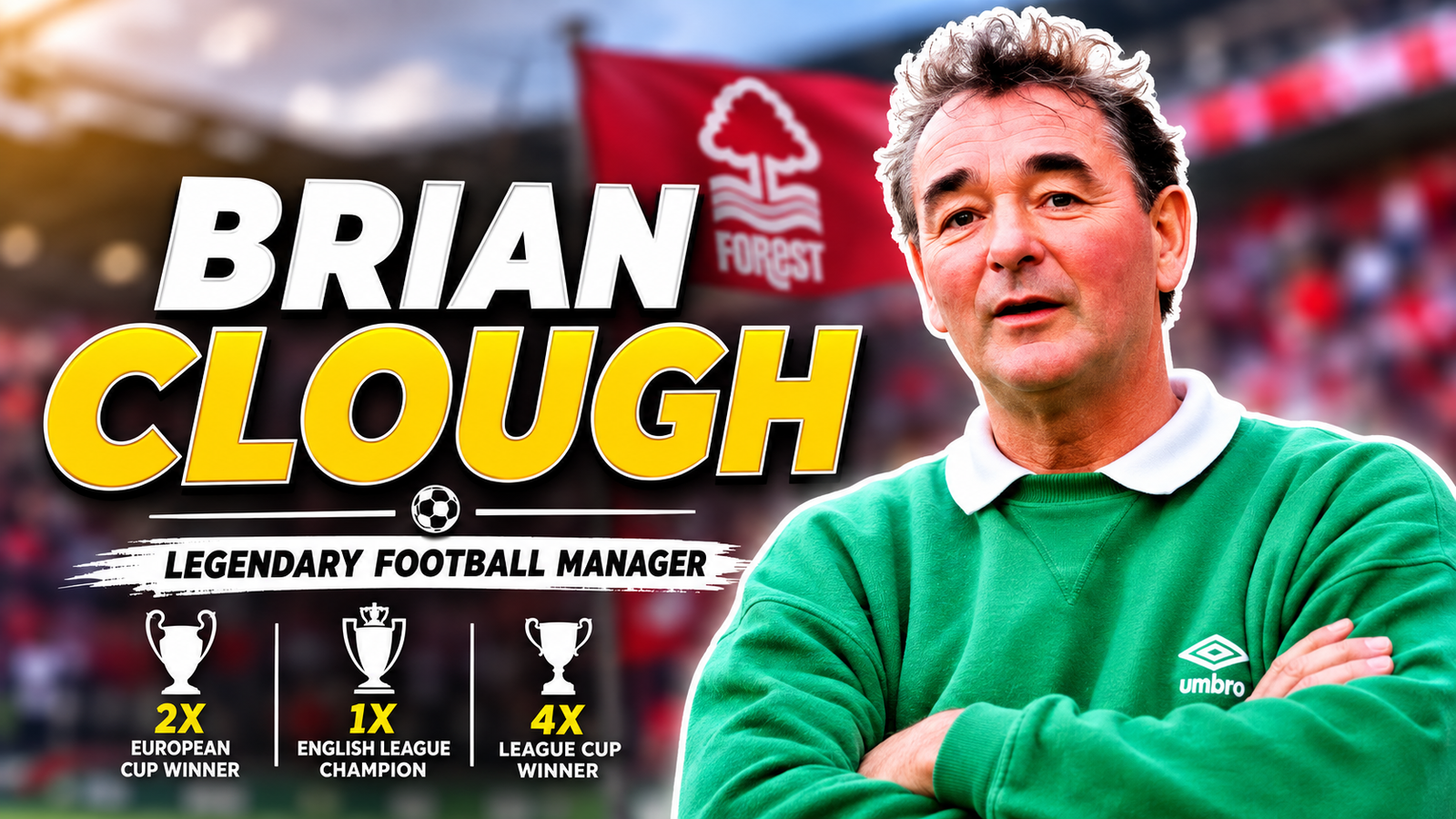
His greatest achievement came at Nottingham Forest. He took the club from the Second Division and turned it into English champions before winning the European Cup in both 1979 and 1980. Nottingham Forest also won four League Cups during his long period as manager.
Before becoming a manager, Clough was also an excellent goalscorer for Middlesbrough and Sunderland. A serious knee injury ended his playing career early, but his move into management created one of the most memorable careers in English football.
Brian Clough died on 20 September 2004, aged 69. His football achievements are still remembered in Middlesbrough, Derby and Nottingham.
Brian Clough Quick Bio
| Detail | Information |
|---|---|
| Full name | Brian Howard Clough |
| Date of birth | 21 March 1935 |
| Birthplace | Middlesbrough, England |
| Profession | Former football player and manager |
| Playing position | Centre-forward |
| Main playing clubs | Middlesbrough, Sunderland |
| England senior appearances | 2 |
| Major managed clubs | Derby County, Leeds United, Nottingham Forest |
| Derby league title | 1971–72 |
| Nottingham Forest league title | 1977–78 |
| European Cups | 1979 and 1980 |
| Nottingham Forest League Cups | 4 |
| Honour | OBE |
| Retirement from management | 1993 |
| Date of death | 20 September 2004 |
| Age at death | 69 |
Clough received an OBE for services to football in 1991 and was later inducted into the National Football Museum Hall of Fame.
Who Was Brian Clough?
Brian Clough was a former English footballer who became one of the most important managers in the history of English club football.
He was not famous simply because he managed successful teams. What made his record unusual was the clubs he turned into champions.
Derby County had not previously won the English league championship when Clough led them to the title in the 1971–72 season. Nottingham Forest then achieved an even more dramatic rise under him.
Forest went from the Second Division to becoming English champions and then European champions in a very short period.
Clough was also known for his confident personality, memorable interviews and direct way of dealing with players.
Brian Clough’s Early Football Career
Clough grew up in Middlesbrough and developed into a centre-forward.
His first major professional club was Middlesbrough.
He became a highly productive goalscorer and later moved to Sunderland. His club scoring record made him one of the strongest goalscorers of his era, although his England senior career was surprisingly short.
Clough played only two senior matches for England, both in 1959.
His playing career changed dramatically after a serious knee injury suffered while playing for Sunderland in December 1962.
He attempted to return to football but was unable to regain his previous level and eventually stopped playing professionally.
That early ending opened a completely different path for his career: football management.
How Good Was Brian Clough as a Player?
It is easy to remember Clough mainly as a manager, but his scoring record as a player was impressive.
His detailed career record gives him:
- 197 league goals in 213 appearances for Middlesbrough
- 54 league goals in 61 appearances for Sunderland
- 2 senior England appearances
These numbers show that Clough was an established goalscorer long before he became famous as a manager.
His knee injury meant supporters never discovered how long he could have continued scoring at that level.
Brian Clough’s First Management Job
Clough began his Football League management career with Hartlepools United, then known as Hartlepools United, in 1965.
He was only around 30 years old.
An important person alongside him was Peter Taylor.
Taylor became Clough’s trusted assistant and played a major role in identifying players and helping build successful teams.
The Clough-Taylor partnership later became central to the success of Derby County and Nottingham Forest.
Brian Clough at Derby County
Brian Clough became Derby County manager in 1967.
At that time, Derby were playing in the Second Division.
Progress came quickly.
Clough and Taylor reshaped the squad and guided Derby to the Second Division championship in 1968–69, earning promotion to England’s top level.
The biggest breakthrough came only a few years later.
Derby County Win the English League
During the 1971–72 season, Derby County became English First Division champions.
It was the club’s first top-flight league championship. Derby County’s official records list Clough as manager from 1967 to 1973 and credit his period with the Second Division title, First Division title and a European Cup semi-final appearance.
The title established Clough as one of England’s leading managers.
Derby also reached the European Cup semi-finals in 1972–73.
His relationship with the Derby board later became difficult, and Clough and Taylor left the club in October 1973.
Brighton & Hove Albion
After leaving Derby County, Clough joined Brighton & Hove Albion.
His time there was short and did not produce the same success he had achieved at Derby.
Peter Taylor remained at Brighton when Clough left for his next major job.
Why Did Brian Clough Manage Leeds United for Only 44 Days?
One of the most searched questions about Brian Clough concerns his time at Leeds United.
Clough became Leeds manager in 1974, taking over after Don Revie.
The appointment was difficult from the beginning because Clough had previously criticised Revie’s Leeds team.
His time at Elland Road lasted only 44 days. Leeds United’s own historical material confirms that Clough’s spell ended after just 44 days before Jimmy Armfield later took charge.
The short Leeds period later became one of the most famous episodes of Clough’s career.
However, it did not define him.
His next job produced far greater success.
Brian Clough at Nottingham Forest
Clough became Nottingham Forest manager in January 1975.
Forest were then playing in England’s second tier.
Peter Taylor later joined him again, restoring the managerial partnership that had worked so well at Derby.
What happened next became one of the most remarkable periods in English club football.
Nottingham Forest Win Promotion
Forest earned promotion to the First Division during the 1976–77 season.
Many newly promoted teams simply aim to remain in the top division.
Clough’s Forest did much more.
Nottingham Forest Become English Champions
In their first season back in the First Division, Nottingham Forest won the 1977–78 English league championship.
They also won the League Cup.
UEFA records that Clough won the English title with Forest immediately after promotion and later guided them to extraordinary success in Europe.
This meant Clough had now won England’s top league with both Derby County and Nottingham Forest.
For readers interested in modern English football careers, you can also read about Todd Cantwell’s football career and current club on WriteBlog.
Brian Clough and the 1979 European Cup
Nottingham Forest’s success did not stop with the English league.
They entered the European Cup and reached the 1979 final against Malmö FF.
Forest won the match 1–0.
Trevor Francis scored the decisive goal, giving Nottingham Forest their first European Cup.
It was extraordinary because only a short time earlier the club had been competing in England’s second tier.
Nottingham Forest Win the European Cup Again
Winning the European Cup once was a major achievement.
Clough’s team then did it again.
Nottingham Forest returned to the final in 1980, where they faced Hamburger SV.
Forest won 1–0 and became European champions for a second consecutive season.
The club’s official honours record confirms European Cup victories in 1979 and 1980.
Readers who want an authoritative European-football account can also see UEFA’s Brian Clough profile, which details his league and European achievements.
What Trophies Did Brian Clough Win at Nottingham Forest?
Clough’s major Nottingham Forest achievements included:
- First Division championship — 1977–78
- European Cup — 1978–79
- European Cup — 1979–80
- European Super Cup
- League Cup — 1977–78
- League Cup — 1978–79
- League Cup — 1988–89
- League Cup — 1989–90
Forest also reached other major finals during his long spell at the club.
The National Football Museum records his 18 years at Forest and highlights the league championship, two European Cups and four League Cup victories as the central achievements of his time there.
Why Was Peter Taylor Important to Brian Clough?
Peter Taylor was much more than an ordinary assistant manager.
Clough and Taylor worked together at Hartlepools United, Derby County and Nottingham Forest.
Taylor became especially respected for identifying players and understanding whether they could fit into a team.
Clough’s ability to motivate players and Taylor’s recruitment skills created a powerful partnership.
Their work together was important in building both Derby’s championship side and the Nottingham Forest team that became European champions.
What Was Brian Clough’s Management Style?
Clough became famous for keeping football relatively simple.
He valued passing, confidence and players understanding exactly what they were expected to do.
Former Forest players have repeatedly described the belief he created inside the team.
UEFA’s profile includes testimony from players and managers who worked with or studied Clough. The common theme is that he had an unusual ability to make footballers believe they could defeat stronger-looking opponents.
He was also different from many managers in front of television cameras.
Clough was direct, confident and sometimes controversial. His interviews became almost as famous as some of his football results.
Did Brian Clough Ever Manage England?
No.
Brian Clough never became manager of the England senior national team.
The National Football Museum says he was interviewed for the England job in 1977 and 1982, but he was not appointed.
Because of his success with Derby County and Nottingham Forest, he is often remembered as one of the greatest English managers never to manage the national team.
Brian Clough’s Family
Brian Clough was married to Barbara Clough.
Public family records connected with his Middlesbrough memorial identify their three children as:
- Simon
- Nigel
- Elizabeth
His son Nigel Clough also became a professional footballer and later a football manager.
The family remained closely connected to Brian Clough’s public legacy after his death. Barbara and their children attended the unveiling of his statue in Middlesbrough’s Albert Park in 2007.
For another English Football League story, readers can explore Jay Matete’s football career and key facts on WriteBlog.
When Did Brian Clough Retire?
Clough remained Nottingham Forest manager until 1993.
His Forest managerial period lasted around 18 years, making it by far the longest spell of his career.
His final season ended with Forest being relegated from the top division.
After leaving the club, Clough retired from football management.
His career record lists his Nottingham Forest period from January 1975 until May 1993.
When Did Brian Clough Die?
Brian Clough died on 20 September 2004, aged 69.
Contemporary reporting stated that he died from stomach cancer.
His death led to major tributes from Derby County, Nottingham Forest and the wider football community.
Brian Clough’s OBE and Football Honours
Clough was appointed an Officer of the Order of the British Empire (OBE) for his services to football in 1991.
He was also inducted into the National Football Museum Hall of Fame.
These honours recognised a career that had included major success as both a player and manager, although his managerial achievements remain the main reason his name is remembered around the world.
Brian Clough’s Legacy
Brian Clough’s influence can still be seen many years after his death.
A section of the A52 connecting Derby and Nottingham was renamed Brian Clough Way.
Statues celebrating him have also been erected in Middlesbrough, Derby and Nottingham.
Derby County and Nottingham Forest also compete for the Brian Clough Trophy when the clubs meet.
His Middlesbrough statue stands in Albert Park, close to the area where he grew up.
Most importantly, his football achievements remain part of the permanent history of Derby County and Nottingham Forest.
Why Is Brian Clough Still Famous?
Brian Clough remains famous because very few managers have achieved what he did.
He did not need to manage one of England’s traditionally biggest clubs to win major trophies.
He guided Derby County to their first English league championship.
He then took Nottingham Forest from the second tier to:
- promotion
- an English league championship
- four League Cups
- two consecutive European Cups
That rapid rise explains why his name remains important whenever football supporters discuss the greatest English managers.
Frequently Asked Questions
Who was Brian Clough?
Brian Clough was an English football player and manager best known for managing Derby County and Nottingham Forest.
When was Brian Clough born?
He was born on 21 March 1935 in Middlesbrough, England.
Which clubs did Brian Clough play for?
His main professional clubs were Middlesbrough and Sunderland.
How many times did Brian Clough win the European Cup?
He won the European Cup twice as Nottingham Forest manager, in 1979 and 1980.
Did Brian Clough win the English league?
Yes. He won the English First Division with Derby County in 1971–72 and Nottingham Forest in 1977–78.
How long was Brian Clough manager of Leeds United?
His Leeds United spell lasted only 44 days in 1974.
Did Brian Clough manage England?
No. He was interviewed for the England manager’s job but was never appointed.
Who was Brian Clough’s assistant?
Peter Taylor was his most famous managerial partner. They worked together during important periods at Hartlepools United, Derby County and Nottingham Forest.
When did Brian Clough retire?
He retired from football management in 1993 after leaving Nottingham Forest.
When did Brian Clough die?
Brian Clough died on 20 September 2004, aged 69.
Why is Brian Clough famous?
He is mainly famous for winning league championships with Derby County and Nottingham Forest and leading Forest to consecutive European Cup victories in 1979 and 1980.
Final Words
Brian Clough’s football story is unusual because he achieved major success as both a player and a manager.
A knee injury ended his playing career earlier than expected, but management gave him a new path.
He helped Derby County rise from the Second Division and become English champions. He later produced an even greater achievement with Nottingham Forest, taking the club from England’s second tier to a league championship and two consecutive European Cups.
Clough retired in 1993 and died in 2004, but the trophies, statues, Brian Clough Way and continued recognition from Derby County and Nottingham Forest keep his name connected to English football.
His record explains the simple answer to why Brian Clough is still remembered: he turned clubs that were not expected to dominate English and European football into champions.
