Introduction
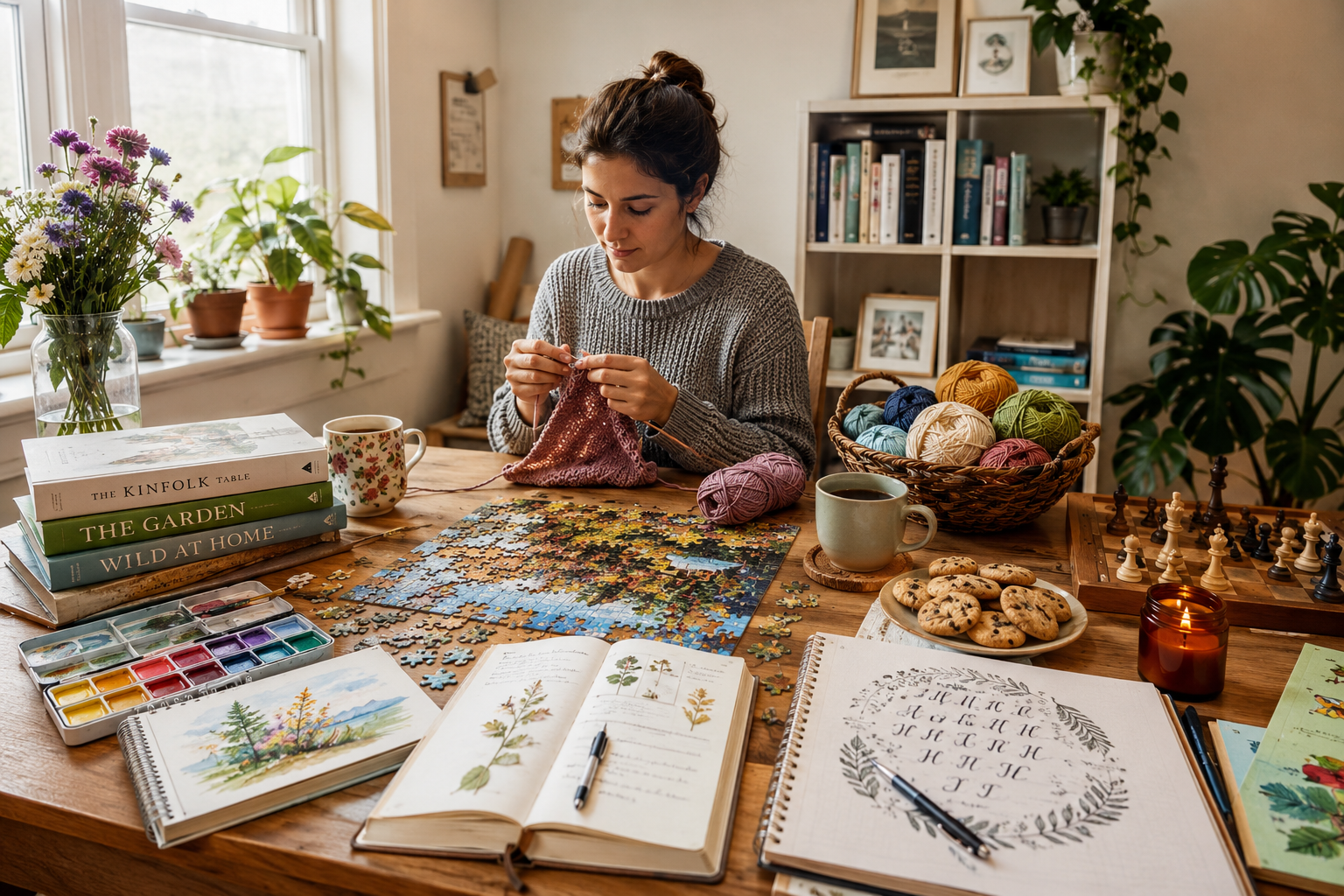
Analogue hobbies for adults at home are simple activities you can enjoy without depending on a phone, computer, television, or other digital screen.
Reading a physical book, knitting, painting, solving a puzzle, writing in a journal, gardening, and baking are all good examples.
These hobbies are becoming popular again as more people look for enjoyable ways to spend their free time away from screens. Recent reports have highlighted growing interest in activities such as journaling, knitting, embroidery, painting, and other hands-on crafts.
The best part is that you do not need a large budget or special room. Many analogue hobbies can be started at home with basic materials.
What Are Analogue Hobbies?
Analogue hobbies are activities that mainly use physical objects, your hands, or your imagination instead of digital technology.
For example, instead of reading an ebook, you read a printed book.
Instead of drawing on a tablet, you draw with pencils and paper.
Instead of playing a game on your phone, you complete a jigsaw puzzle or play a board game.
Going analogue does not mean you must completely stop using technology. The idea is simply to create some free time where a screen is not the centre of your attention.
Best Analogue Hobbies for Adults at Home
Here are 21 easy ideas you can try.
1. Reading Physical Books
Reading is one of the easiest analogue hobbies to start.
Choose a novel, biography, history book, magazine, comic, or any subject that interests you.
Create a comfortable reading corner and keep your phone somewhere else while you read.
Even reading a few pages each evening can become an enjoyable routine.
2. Journaling
All you need is a notebook and pen.
You can write about:
- Your day
- Future plans
- Things you learned
- Personal goals
- Interesting ideas
- Things you are grateful for
There are no strict rules.
Your journal can be as simple or creative as you want.
3. Drawing
You do not need to be a professional artist.
Start with a pencil and ordinary paper.
Try drawing household objects, plants, buildings, animals, patterns, or anything you see around you.
The important part is enjoying the activity rather than creating a perfect picture.
4. Painting
Painting gives you more freedom to experiment with colours.
Beginners can start with watercolours, acrylic paints, or paint-by-number kits.
You can paint landscapes, flowers, abstract patterns, or simple objects.
5. Jigsaw Puzzles
Jigsaw puzzles are excellent if you enjoy slow activities that require concentration.
Start with a smaller puzzle if you are new.
A 300- or 500-piece puzzle can be easier to manage than immediately attempting a very large one.
Keep it on a spare table and complete a little whenever you have free time.
6. Crossword Puzzles
A crossword puzzle can turn a quiet evening into a small mental challenge.
You can buy crossword books that contain dozens or hundreds of puzzles.
Other paper-based options include:
- Word searches
- Sudoku
- Logic puzzles
- Number puzzles
- Riddles
7. Knitting
Knitting is one of the classic analogue hobbies that has become popular again.
With yarn and knitting needles, you can eventually create scarves, hats, blankets, clothing, and decorations.
Start with a simple beginner project before trying complicated patterns.
8. Crochet
Crochet is similar to knitting but normally uses one crochet hook.
Beginners can make small items such as coasters, simple squares, scarves, or decorations.
Knitting, crochet, needlework, and similar traditional crafts have received renewed attention during the wider move toward analogue hobbies.
9. Embroidery
Embroidery involves creating pictures or patterns on fabric using thread and a needle.
Beginner embroidery kits usually provide a pattern and the materials needed to complete it.
This makes it an accessible hobby for people who have never tried needlework before.
10. Sewing
Learning basic sewing can be both enjoyable and useful.
You might begin by:
- Repairing a button
- Fixing a small tear
- Making a cushion cover
- Creating a simple bag
- Altering old clothing
As your skills improve, you can take on larger projects.
11. Scrapbooking
Scrapbooking lets you turn memories into a physical book.
You can use:
- Printed photographs
- Tickets
- Postcards
- Coloured paper
- Stickers
- Handwritten notes
- Small souvenirs
Each page can represent a holiday, celebration, person, year, or special memory.
12. Junk Journaling
Junk journaling combines journaling, collage, drawing, paper crafts, and scrapbooking.
Instead of buying expensive supplies, people often reuse ordinary paper items such as packaging, receipts, old cards, magazine pieces, labels, or tickets.
It is one of the analogue activities that has attracted attention during the recent interest in offline hobbies.
13. Calligraphy and Hand Lettering
If you enjoy beautiful handwriting, try calligraphy.
Start with a pen, paper, and a few basic letter styles.
You can eventually use your skills to make:
- Greeting cards
- Invitations
- Quotes
- Gift tags
- Wall decorations
14. Writing Letters
Handwritten letters offer a more traditional way to communicate.
You could write to a friend, relative, partner, or pen pal.
Unlike a quick text message, a physical letter can become something the receiver keeps for years.
15. Playing a Musical Instrument
A musical instrument can become a rewarding long-term hobby.
At home, popular choices include:
- Guitar
- Ukulele
- Keyboard
- Piano
- Harmonica
Start with basic notes or chords and practise for a short period each day.
16. Baking
Baking is another hobby where you create something physical with your hands.
Easy beginner projects include:
- Bread
- Cookies
- Cakes
- Muffins
- Biscuits
- Pies
It also gives you something you can share with family or friends.
17. Cooking From Scratch
Cooking does not have to be only a daily responsibility.
It can become a creative hobby.
Choose one new dish each week and learn how to prepare it without relying on ready-made meals.
You could eventually create your own handwritten recipe book containing your favourite meals.
18. Indoor Gardening
You do not need a large garden.
A sunny windowsill can be enough for small plants or herbs.
Popular choices include basil, mint, parsley, and other plants suited to indoor conditions.
Caring for plants can also give you a small daily routine away from screens.
19. Pressing Flowers
Flower pressing is a very simple traditional craft.
Flowers and leaves can be dried between sheets of paper and pressed under heavy books or with a flower press.
Once dried, they can be used in:
- Cards
- Journals
- Bookmarks
- Frames
- Scrapbooks
20. Board Games
Board games are especially useful if you want an analogue hobby you can share with other people at home.
Depending on the game, two people may be enough.
Card games, chess, checkers, dominoes, and traditional tabletop games are other screen-free choices.
21. Model Building
Model building is ideal for adults who enjoy detailed hands-on projects.
You could build miniature:
- Cars
- Aircraft
- Ships
- Buildings
- Trains
Some models can be completed in an afternoon, while larger projects may take several weeks.
Cheap Analogue Hobbies to Start at Home
You do not need to spend much money.
Some of the cheapest options include:
| Hobby | Basic Items Needed |
|---|---|
| Journaling | Notebook and pen |
| Drawing | Pencil and paper |
| Reading | Physical book |
| Letter writing | Paper, pen and envelope |
| Crossword puzzles | Puzzle book and pencil |
| Gardening | Small pot, soil and seeds |
| Scrapbooking | Old photos and paper |
| Origami | Paper |
| Card games | Pack of playing cards |
Start with materials you already own before buying expensive equipment.
Why Are Analogue Hobbies Becoming Popular?
Modern life involves a lot of screens.
Phones, computers, streaming services, social media, online work, and digital entertainment can occupy much of the day.
This has helped create renewed interest in hobbies based around physical materials and hands-on activities.
In 2026, several publications reported increased interest in activities including knitting, physical books, puzzles, journaling, crafting, and other offline pastimes.
Research on leisure activities more broadly has also found associations between enjoyable hobbies and aspects of mental and physical well-being, although the effects can vary depending on the person and activity.
The goal does not have to be eliminating technology.
It can simply mean creating a healthier balance between digital entertainment and activities you enjoy in the physical world.
How to Choose an Analogue Hobby
Do not choose a hobby simply because it is fashionable.
Ask yourself three questions:
What do I enjoy?
Someone who likes making things might prefer crochet or woodworking, while someone who enjoys quiet activities might prefer reading.
How much space do I have?
Drawing requires almost no space, while large puzzles or model building may need a dedicated table.
How much do I want to spend?
Start cheaply.
You can always buy better equipment once you know you genuinely enjoy the hobby.
Start Small
You do not need to spend three hours on your new hobby.
Try 15 or 20 minutes.
Keep the materials somewhere easy to reach.
For example, leave your book beside your favourite chair or keep your journal and pen on your bedside table.
Experts interviewed by the Associated Press about screen-free hobbies similarly recommended starting small, experimenting with different activities, and making the chosen hobby easy to access.
The easier the hobby is to begin, the more likely you are to actually do it.
Frequently Asked Questions
What are analogue hobbies?
Analogue hobbies are mainly non-digital activities involving physical materials, hands-on skills, movement, creativity, or traditional forms of entertainment.
What are good analogue hobbies for adults at home?
Reading, journaling, knitting, crochet, painting, drawing, puzzles, baking, gardening, sewing, scrapbooking, and playing musical instruments are good options.
What is the easiest analogue hobby to start?
Journaling and reading are among the easiest because they require very little equipment.
What analogue hobbies are inexpensive?
Drawing, journaling, reading borrowed books, origami, puzzles, card games, letter writing, and simple gardening can all be inexpensive.
Can an analogue hobby help reduce screen time?
It can give you something enjoyable to do during periods when you would otherwise use a phone, computer, or television.
Are analogue hobbies only for creative people?
No.
Chess, puzzles, reading, cooking, gardening, model building, music, and board games are all analogue hobbies too.
Can adults start a new hobby at any age?
Yes. Many hobbies have beginner-friendly options, so you can choose an activity that matches your interests, budget, available space, and abilities.
Do I need to completely stop using technology?
No. Analogue hobbies are about adding enjoyable offline activities to your life, not necessarily removing technology completely.
Final Thoughts
Analogue hobbies for adults at home offer a simple alternative to spending every free moment on a screen.
You could read a physical book, start a journal, complete a puzzle, learn crochet, grow herbs, paint, bake, write letters, or build models.
There is no single best analogue hobby.
The best one is the activity you genuinely enjoy enough to return to regularly.
Choose one simple hobby, gather the basic materials, put your phone aside for a short time, and give it a try.
