Introduction
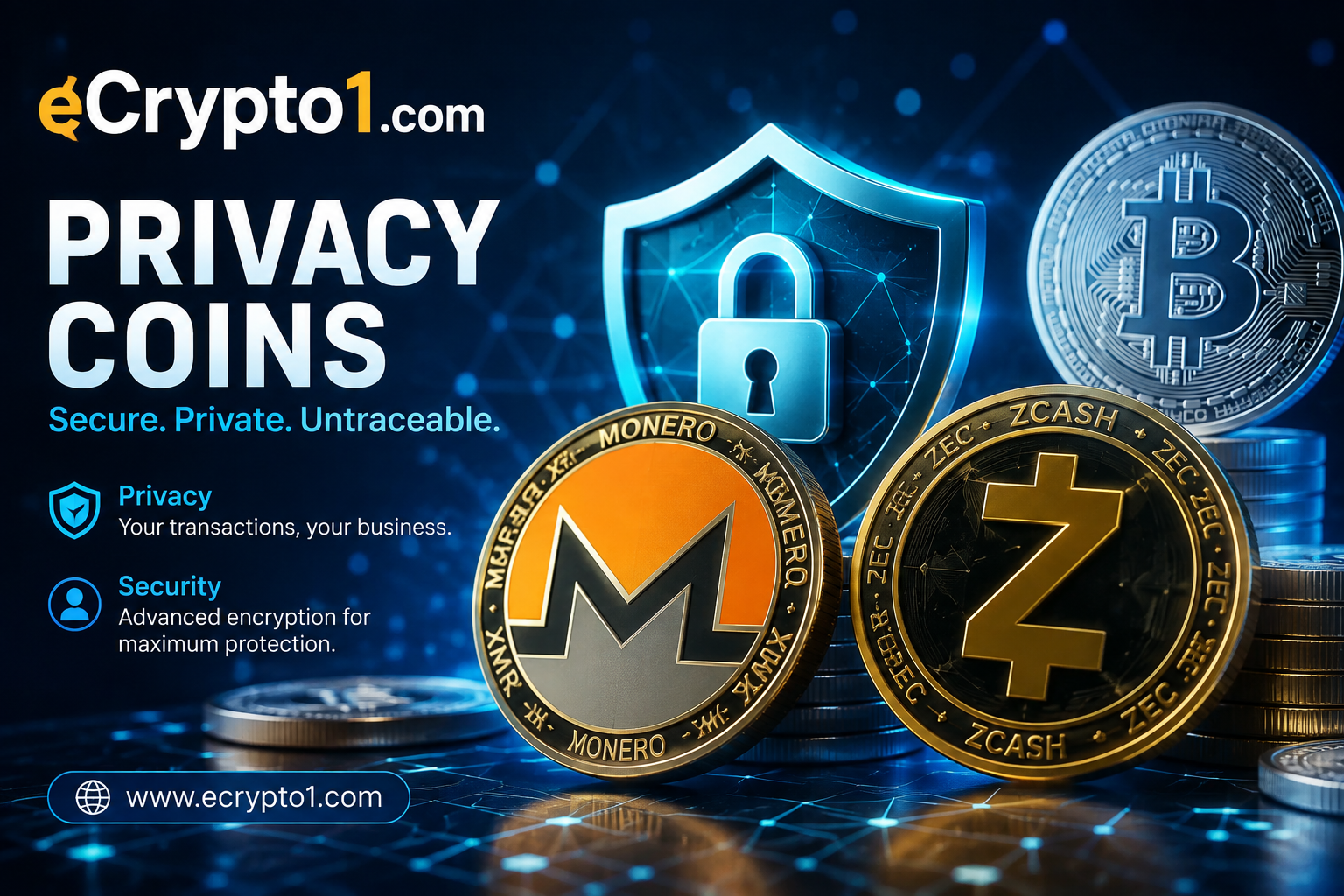
eCrypto1.com Privacy Coins is a search term linked with online discussions about privacy-focused cryptocurrency and crypto security. Privacy coins are digital currencies designed to hide more transaction information than ordinary public-blockchain cryptocurrencies.
However, there is an important point to understand. As of August 12, 2026, the public eCrypto1.com website is accessible only through a verification screen during our check, and no clearly indexed official eCrypto1.com page explaining its privacy-coin services could be independently verified. Therefore, claims that the website officially offers, trades, stores, or supports particular privacy coins should not be treated as confirmed without checking the platform directly.
The privacy-coin concept itself is well established. Privacy-focused cryptocurrencies can use cryptographic tools to hide information such as the sender, recipient, or transaction amount. Monero and Zcash are two of the best-known examples, although they approach privacy differently.
What Does eCrypto1.com Privacy Coins Mean?
People searching for eCrypto1.com Privacy Coins are generally trying to understand the connection between eCrypto1.com and cryptocurrencies designed for greater financial privacy.
Several third-party websites have written about eCrypto1.com. However, their descriptions are not fully consistent. One review questioned the depth of the site’s privacy-coin coverage, while another third-party article claimed that it supports assets such as Monero and Zcash. Because these statements could not be confirmed from an accessible official eCrypto1.com privacy-coin page, readers should treat them as third-party claims rather than verified platform features.
This distinction matters because cryptocurrency users should verify financial services directly before depositing money, connecting a wallet, or sharing personal information.
What Are Privacy Coins?
Privacy coins are cryptocurrencies built to provide stronger transaction confidentiality.
Most ordinary blockchain transactions are recorded on a public ledger. Although a blockchain address may not show a person’s real name, transaction history, balances, and connections between addresses can sometimes be analysed.
Privacy coins try to reduce this visibility.
TRM Labs describes privacy coins, also called anonymity-enhanced coins, as cryptocurrencies designed to increase user privacy and transaction anonymity through technologies that obscure transaction information.
That does not mean every privacy coin works in exactly the same way.
Some provide privacy automatically, while others allow users to choose between public and private transactions.
How Privacy Coins Work
Privacy-focused networks can use several cryptographic methods.
Ring Signatures
Ring signatures can make it difficult to determine which member of a group actually authorised a transaction.
Monero uses ring-signature technology as part of its privacy system. Its official documentation explains that ring signatures help obscure which transaction output is actually being spent.
Stealth Addresses
A stealth address allows a new one-time destination address to be created for a payment.
This makes it harder for an outside observer to connect multiple transactions to the same recipient.
Monero’s documentation states that stealth addresses generate unique one-time addresses for incoming payments rather than repeatedly exposing the recipient’s main published address on the blockchain.
Confidential Transaction Amounts
Some privacy technologies also hide the amount being transferred.
Monero uses Ring Confidential Transactions, commonly called RingCT, to conceal transaction amounts.
Zero-Knowledge Proofs
Zero-knowledge proofs allow someone to prove that information is valid without revealing all of the underlying information.
Zcash uses zero-knowledge technology for shielded transactions. Its documentation explains that these proofs can allow the network to verify a transaction without publicly exposing sensitive financial information.
Monero and Privacy
Monero, represented by the ticker XMR, was designed with privacy as a central feature.
According to the official Monero project, its transactions use stealth addresses, ring signatures, and RingCT to hide information about the sender, recipient, and transferred amount.
A major difference between Monero and some other privacy cryptocurrencies is that Monero’s privacy protections are built into normal transactions rather than requiring users to select a separate private mode.
For this reason, Monero frequently appears in general discussions about privacy coins.
Zcash and Privacy
Zcash, or ZEC, takes a different approach.
Its network supports privacy-protecting shielded addresses as well as transparent transaction options.
According to the official Zcash documentation, shielded addresses keep financial information private, while transparent addresses make transaction information publicly visible.
Zcash uses zero-knowledge cryptography to verify protected transactions without exposing all of their transaction data.
Therefore, it is important not to assume that every Zcash transaction automatically provides the same level of privacy.
Why People Use Privacy Coins
There are legitimate reasons someone may want greater financial privacy.
For example, a person may not want strangers to see their digital-asset balance after receiving a payment. A business may also prefer not to expose its entire transaction history to customers or competitors.
Financial privacy can therefore serve ordinary purposes rather than automatically indicating illegal activity.
At the same time, stronger anonymity can create regulatory and financial-crime concerns. The Financial Action Task Force has identified privacy-enhancing virtual assets and other techniques that obscure transactions as areas requiring attention under anti-money-laundering and counter-terrorist-financing frameworks.
Are Privacy Coins Completely Anonymous?
Users should be careful with the word anonymous.
A privacy-focused blockchain may hide important transaction information, but complete anonymity can depend on much more than the cryptocurrency protocol itself.
For example, privacy can potentially be reduced through:
- Exchange account information
- Identity-verification requirements
- Device or network information
- Wallet mistakes
- Address reuse
- Malware or phishing
- Information voluntarily shared by the user
Therefore, using a privacy coin does not automatically guarantee that a person’s entire online identity becomes invisible.
Privacy technology protects certain types of blockchain information. It does not replace good cybersecurity practices.
eCrypto1.com Privacy Coins and Platform Verification
Anyone researching eCrypto1.com Privacy Coins should separate two questions.
The first is whether privacy coins are genuine cryptocurrency technology. They are, and major projects such as Monero and Zcash provide extensive technical documentation about their privacy systems.
The second question is what eCrypto1.com itself officially provides.
That part requires more caution.
During our August 12, 2026 check, the eCrypto1.com homepage presented a verification/loading page rather than publicly accessible information describing privacy-coin products or services.
Consequently, users should confirm features directly on the platform before assuming that it offers a particular coin, wallet, exchange function, or security product.
What to Check Before Using a Crypto Platform
Before sending cryptocurrency to any website, users should perform basic checks.
Confirm the exact domain name first. Cryptocurrency scams often use addresses that look similar to genuine services.
Next, check whether the company clearly explains what service it provides, who operates it, what security measures it uses, and what fees or withdrawal conditions apply.
Users should also avoid sharing wallet seed phrases or private keys. A legitimate transaction normally does not require handing a website the recovery phrase for an unrelated self-custody wallet.
It is also sensible to begin with a small amount instead of transferring a large balance immediately.
Privacy Coins and Regulation
Privacy coins exist within a complicated regulatory environment.
Rules can differ greatly between countries and between cryptocurrency exchanges.
Financial regulators are particularly interested in technologies that make transaction tracing harder because these features can affect anti-money-laundering controls.
The FATF has recognised that anonymity-enhanced cryptocurrencies may provide additional transaction-obscuring capabilities and has highlighted related risks for virtual-asset businesses.
Therefore, availability on exchanges can vary by location and may change as regulations or company compliance policies develop.
Users should always check the laws and platform rules that apply in their own country.
Advantages of Privacy-Focused Cryptocurrency
Privacy technology can offer several useful qualities.
It may reduce public exposure of balances and payment histories. It can also give users greater control over how much financial information they reveal to other blockchain participants.
Privacy can additionally improve fungibility. If transaction histories are difficult to trace, individual units of a cryptocurrency are less easily judged based on how previous owners used them.
However, these benefits need to be considered alongside regulatory restrictions, exchange availability, cybersecurity risks, and the complexity of managing cryptocurrency safely.
Risks to Understand
Privacy coins are still cryptocurrencies, so they carry many of the same risks as other digital assets.
Prices can change sharply.
Wallet access can be permanently lost if recovery information is lost.
Fake websites can imitate legitimate projects.
A private transaction does not protect users from phishing, malware, fraudulent investments, or compromised devices.
Furthermore, stronger blockchain privacy can make recovering stolen funds more difficult.
For this reason, privacy should be considered one part of crypto security rather than a complete security solution.
Is eCrypto1.com Privacy Coins Safe?
There is not enough verified official information available from the publicly accessible eCrypto1.com pages checked for this article to make a reliable claim that an eCrypto1.com Privacy Coins service is either safe or unsafe.
That is the most responsible conclusion.
Users should not interpret third-party promotional articles as proof that a platform has particular security systems, supported cryptocurrencies, licences, or protections.
Instead, verify those details directly before depositing assets or providing sensitive information.
Frequently Asked Questions
What is eCrypto1.com Privacy Coins?
The phrase generally appears in online searches and articles connecting eCrypto1.com with privacy-focused cryptocurrencies. However, an accessible official eCrypto1.com page confirming a specific privacy-coin product could not be verified during our August 12, 2026 check.
What is a privacy coin?
A privacy coin is a cryptocurrency designed to conceal more transaction information than a typical transparent blockchain.
Is Monero a privacy coin?
Yes. Monero is specifically designed around private transactions and uses several technologies to conceal sender, recipient, and transaction information.
Is Zcash a privacy coin?
Zcash is a privacy-focused cryptocurrency that supports shielded transactions using zero-knowledge technology. It also supports transparent transactions.
Are privacy coins illegal?
There is no single worldwide rule covering privacy coins. Their legal and exchange status depends on the country, platform, and applicable financial regulations.
Do privacy coins guarantee complete anonymity?
No. Blockchain privacy technology can conceal transaction information, but user behaviour, exchanges, cybersecurity problems, and other information can still affect privacy.
Should I invest through eCrypto1.com?
This article cannot confirm whether the platform is appropriate for a particular investment. Users should independently verify the site’s current services, security, legal status, fees, and withdrawal rules before transferring cryptocurrency.
Final Thoughts
eCrypto1.com Privacy Coins is best understood as a search topic connecting the eCrypto1.com name with the broader world of privacy-focused cryptocurrency.
Privacy coins themselves are real and established technologies. Monero uses technologies including ring signatures, stealth addresses, and confidential transactions, while Zcash provides shielded transactions using zero-knowledge cryptography.
What should not be assumed is that every feature attributed to eCrypto1.com by third-party websites is officially verified.
For anyone interested in privacy cryptocurrency, the safest approach is to understand the underlying technology, verify platforms independently, protect private keys, and follow the financial rules that apply in their location.
