Introduction
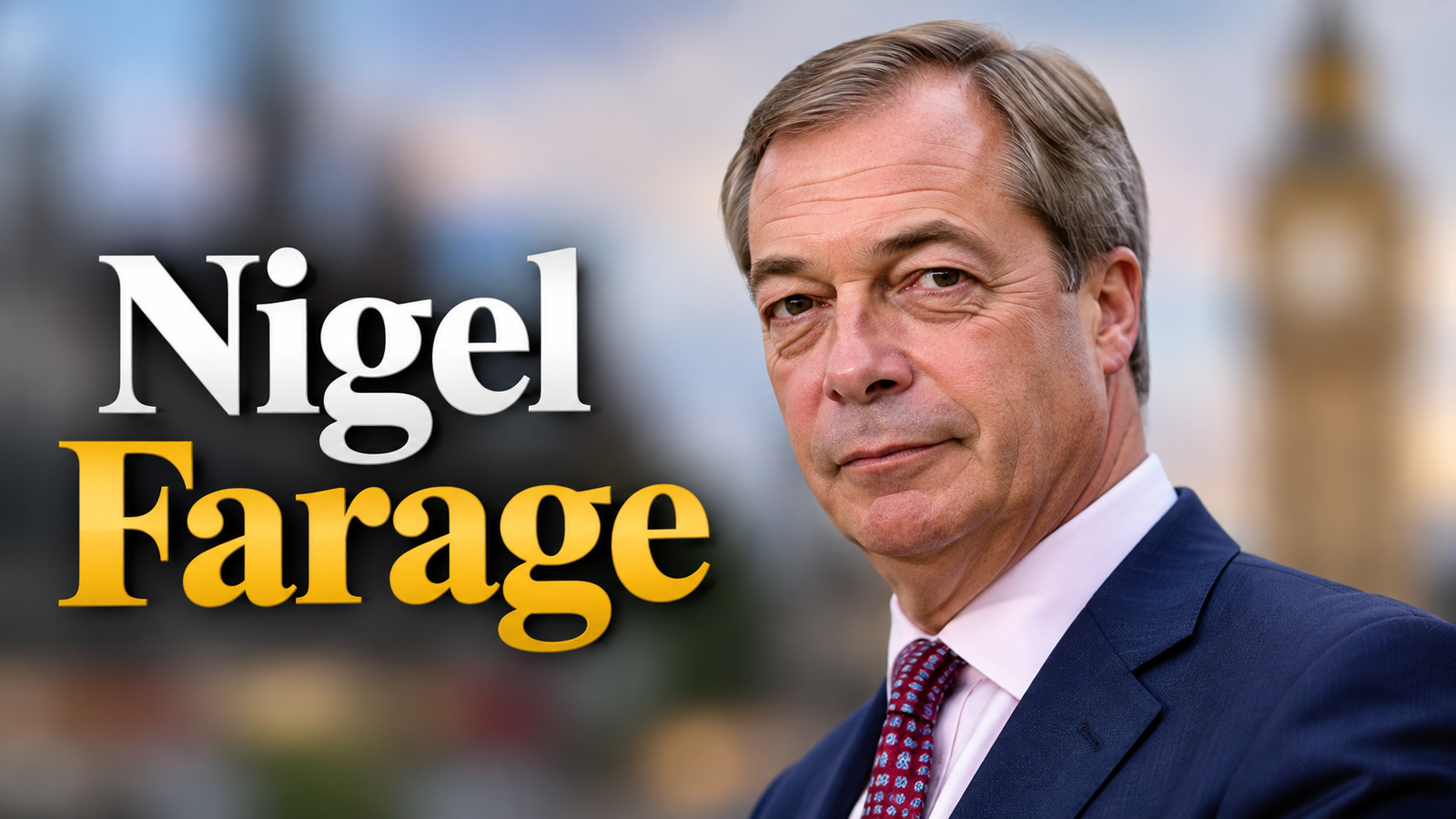
From a London commodities trader to Reform UK leader and Member of Parliament, here’s the story of Nigel Farage, his family, career, public life, and latest political developments.
Nigel Farage is a British politician, broadcaster, and former commodities trader. He is best known for campaigning for Brexit and leading the Reform UK party.
His political journey has been long. For years, he fought elections without winning a seat in the House of Commons. Still, he kept campaigning.
That changed in July 2024.
Farage finally entered the House of Commons after winning the Clacton constituency in Essex. He later won a second election there in August 2026.
Today, he remains Reform UK’s leader and one of Britain’s most widely discussed political figures.
Quick Facts
| Detail | Information |
|---|---|
| Full name | Nigel Paul Farage |
| Date of birth | 3 April 1964 |
| Age | 62 years old (October 2026) |
| Birthplace | Farnborough, Kent, England |
| Nationality | British |
| Profession | Politician, broadcaster, former trader |
| Education | Dulwich College |
| University | Did not attend |
| Political party | Reform UK |
| Previous party | UK Independence Party (UKIP) |
| Current position | Reform UK leader and MP for Clacton |
| First elected as MP | 4 July 2024 |
| Latest parliamentary election | 13 August 2026 |
| First wife | Gráinne Hayes |
| Second wife | Kirsten Mehr |
| Children | Four |
| Known for | Brexit campaign and party leadership |
| Net worth | Not independently verified |
A Childhood in Kent
Nigel Paul Farage was born on 3 April 1964 in Farnborough, Kent.
His father, Guy Justus Oscar Farage, worked in the financial markets. His mother was Barbara Farage, née Stevens.
He grew up in south-east England.
Politics interested him early. As a teenager, he supported the Conservative Party and admired several politicians associated with its economic policies.
His school years also mattered.
Farage attended Dulwich College, an independent school in south London. He joined the Conservative Party during his teenage years.
But university wasn’t his next stop.
Instead, he chose work.
School Days and His First Job
Farage finished studying at Dulwich College in 1982.
He did not attend university.
Instead, he entered London’s commodities trading business, working with firms involved in metals and financial markets.
One of his early employers was Drexel Burnham Lambert.
He later worked in similar trading roles.
The work gave him experience in financial markets before he entered politics full-time.
For several years, his career followed a very different path from the one that later made him famous.
Why He Left the Conservative Party
Farage initially supported the Conservatives.
That relationship changed in 1992.
He opposed the Maastricht Treaty, which helped establish the European Union and expanded European political cooperation.
Farage believed Britain should keep greater control over its own laws and political decisions.
He left the Conservative Party.
In 1993, he helped establish the UK Independence Party, better known as UKIP.
The party wanted Britain to leave the European Union.
At first, UKIP was small. It struggled to gain seats in Westminster and had limited national support.
Farage kept working with the party.
His Rise Through European Politics
A major career change came in 1999.
Farage was elected to the European Parliament, representing South East England.
He remained an MEP until Britain’s withdrawal from the European Union took effect on 31 January 2020.
During those years, his speeches often criticised EU institutions and the transfer of political powers from national governments.
His approach attracted attention.
Supporters welcomed his focus on national sovereignty. Critics disagreed with his arguments and questioned some of his political claims.
He also gained attention through public debates and television appearances.
The European Parliament gave him a national platform, even before he held a seat at Westminster.
The Years Leading UKIP
Farage became UKIP leader in 2006.
He stepped aside in 2009, then returned as leader in 2010.
His campaigns focused heavily on Britain’s relationship with the EU, immigration, and national decision-making.
The party’s electoral support grew.
In the 2014 European Parliament election, UKIP received the largest share of the UK vote, gaining 26.77%.
That was an important election result.
It showed the party could attract significant support beyond its established voters.
Yet success in European elections did not immediately give Farage a seat in the House of Commons.
He lost the South Thanet contest in the 2015 general election.
His Westminster ambitions continued.
The Brexit Referendum of 2016
Brexit is closely connected with Nigel Farage’s political career.
On 23 June 2016, the United Kingdom held a referendum on whether to remain in or leave the European Union.
Farage campaigned for Leave.
He argued that Britain should control its own borders, laws, and political decisions.
He was associated with the Leave.EU campaign, which was separate from the officially designated Vote Leave organisation.
The result was close.
51.9% voted to leave, while 48.1% voted to remain.
Farage welcomed the result.
Still, the referendum had many campaigners, organisations, and political leaders involved. The result cannot be attributed to one individual.
The UK formally left the European Union on 31 January 2020.
Farage’s long campaign for withdrawal had reached its main objective.
From the Brexit Party to Reform UK
The Brexit referendum did not end his political career.
In 2019, Farage became leader of the Brexit Party.
The party strongly criticised delays to Britain’s departure from the European Union.
It won the largest share of the UK vote in the 2019 European Parliament election.
Later, the Brexit Party changed its name to Reform UK.
The new party focused on wider political issues, including immigration, taxation, public services, and government spending.
Farage stepped back from its leadership in 2021.
He continued working in broadcasting and political commentary.
Then, in June 2024, he returned as Reform UK leader and announced that he would stand for Parliament.
This time, he won.
His First Victory in Westminster
Farage contested the Clacton constituency in the general election held on 4 July 2024.
He received 21,225 votes and defeated the Conservative candidate, Giles Watling.
It was his first successful election to the House of Commons.
Before that victory, he had unsuccessfully contested seven Commons elections.
The result gave him a new role.
He was now an elected Westminster politician rather than a campaigner outside the House of Commons.
He began representing constituents in Clacton while continuing to lead Reform UK.
What Happened in August 2026?
Another election followed in 2026.
Farage resigned his parliamentary seat in July while facing questions about a reported £5 million gift from businessman Christopher Harborne.
A parliamentary standards investigation was examining the matter. Farage disputed suggestions that he had broken the rules.
His resignation triggered a by-election.
The vote took place on 13 August 2026.
Farage won again.
The official results showed:
| Candidate | Votes |
|---|---|
| Nigel Farage — Reform UK | 22,239 |
| Count Binface — Count Binface Party | 9,455 |
| John Stevens — Rejoin EU | 492 |
Farage’s majority was 12,784 votes.
Turnout was 44%.
Major political parties did not contest the by-election, so the result took place under different conditions from the 2024 general election.
Farage returned to Parliament.
As of October 2026, the parliamentary investigation into the reported gift remained unresolved. An investigation does not mean a politician has been found guilty of breaking parliamentary rules.
His Views on Immigration and National Borders
Immigration has remained a main subject throughout Farage’s political career.
He supports tighter controls on immigration and asylum.
He has repeatedly argued for stronger border enforcement and changes to Britain’s asylum system.
His party introduced particularly strict asylum proposals in October 2026.
These included suspending new asylum applications for five years and deporting large numbers of people whose claims had previously been accepted.
The proposals attracted criticism from refugee organisations and political opponents.
Critics raised concerns about human rights, legal obligations, and the treatment of families seeking protection.
Farage and Reform UK defended their approach as a way to strengthen border control.
The proposals were party policies, not laws in force.
Other Political Positions
Farage’s political views extend beyond Brexit.
He has supported lower taxes and criticised parts of Britain’s regulatory system.
He frequently argues that small businesses face too many financial pressures.
He has also questioned government net-zero policies and supported greater domestic energy production.
On foreign policy, he has spoken about Britain’s relationship with the United States, European countries, and international institutions.
His political positions have attracted both support and opposition.
Supporters agree with his criticism of the established political parties.
Critics question the economic effects and practicality of some Reform UK proposals.
His Wife, Relationships, and Four Children
Nigel Farage has been married twice.
His first wife was Gráinne Hayes, an Irish nurse.
They married in 1988 and had two children.
Their marriage ended in divorce in 1997.
Farage married Kirsten Mehr, a German national, in 1999. They also have two children.
In 2017, Kirsten confirmed publicly that the couple were living separate lives.
Farage has since been reported to be in a relationship with French political figure Laure Ferrari.
He has four children in total.
Although his family has appeared in some media reports, he has kept much of his children’s private lives away from political coverage.
Serious Accidents and Past Health Problems
Farage has experienced several serious health incidents.
In 1985, he was badly injured after being hit by a car.
He also received treatment for testicular cancer during the 1980s.
Another dangerous incident happened in May 2010.
Farage was travelling in a light aircraft during an election campaign when the aircraft crashed.
It had been towing an election banner.
He survived but suffered injuries.
He later spoke publicly about the accident and its effects.
These are documented events from his past. They do not establish any current medical condition.
Television and Broadcasting Work
Farage built a broadcasting career alongside his political activities.
He worked as a political commentator and presenter, including on GB News.
His programmes covered political debates, government decisions, and current affairs.
He has also appeared on television outside political news.
In 2023, Farage participated in ITV’s I’m a Celebrity… Get Me Out of Here!
He finished third.
Sam Thompson won the series, while former boxer Tony Bellew finished second.
The appearance introduced Farage to audiences who may not have followed his political speeches or party campaigns.
Books and Published Work
Farage has written about his personal experiences and political beliefs.
Two of his best-known books are:
Fighting Bull (2010)
This memoir covers parts of his early life, political experiences, and involvement with UKIP.
The Purple Revolution: The Year That Changed Everything (2015)
This book discusses UKIP’s political rise and the period surrounding the 2014 European elections.
His writing gives readers an account of political events from his own perspective.
It should be read alongside independent reporting and official records.
His Earnings and Business Interests
Farage has received income from several activities.
These include broadcasting, writing, speaking engagements, social media work, and personalised video recordings.
His financial interests are recorded in the official UK Parliament register.
An August 2024 declaration listed a GB News presenting arrangement worth £97,928.40 per month.
It also recorded a Telegraph writing arrangement worth £4,000 per month.
Those were declared arrangements from 2024. They should not be treated as his confirmed current monthly income.
His published interests have also included shares in Thorn In The Side Limited, Farage Media Limited, and Reform UK Party Limited.
He has declared residential property interests.
The parliamentary register provides a public record of certain earnings and assets, but it does not list every detail needed to calculate someone’s total wealth.
Is His Net Worth Publicly Known?
Nigel Farage’s exact net worth has not been independently verified.
Some websites publish estimates, but those figures often lack reliable financial evidence.
His parliamentary financial declarations confirm certain earnings, payments, and business interests.
They do not establish his total personal wealth.
For that reason, it is better not to publish an unsupported figure.
The Coutts Banking Dispute
In 2023, Farage became involved in a public dispute with Coutts, a private bank owned by NatWest.
The dispute concerned the closure of his bank account.
Documents later showed that his public political views had been considered during the bank’s internal assessment.
Farage argued that the decision involved unfair treatment because of his political opinions.
The matter attracted considerable attention.
The BBC apologised for inaccurate initial reporting, while NatWest’s then-chief executive, Dame Alison Rose, acknowledged an error of judgment over a conversation with a journalist.
The incident led to wider debate about banks, political views, and customer treatment.
Public Criticism and Controversies
Farage has faced criticism throughout his political career.
His immigration messaging has been challenged by opponents and campaign groups.
One widely discussed example was a Leave.EU poster shown during the 2016 referendum. Critics argued that it encouraged negative attitudes towards migrants and refugees.
Farage defended the campaign’s focus on immigration.
More recently, Reform UK faced scrutiny over its handling of possible political donations.
In October 2026, the party published an internal investigation into allegations connected with an undercover report about prospective foreign donations.
The internal investigation concluded that no laws had been broken but identified failings in conduct and internal procedures.
A separate police investigation remained ongoing.
These findings concern the party’s handling of the matter and should not be presented as a criminal finding against Farage personally.
His Current Role in British Politics
As of 14 October 2026, Farage is leader of Reform UK and MP for Clacton.
His party continues to campaign on immigration, economic policy, public services, and national sovereignty.
He remains active in public debate.
Recent statements about immigration and asylum policy have again attracted criticism from political opponents and refugee organisations.
His parliamentary role now gives him a direct position in Westminster debates.
After years of campaigning outside the House of Commons, he is working inside it.
That remains a major change in his political career.
Important Dates in His Life
| Year | Event |
|---|---|
| 1964 | Born in Farnborough, Kent |
| 1982 | Finished education at Dulwich College |
| 1988 | Married Gráinne Hayes |
| 1992 | Left the Conservative Party |
| 1993 | Helped establish UKIP |
| 1999 | First elected to the European Parliament |
| 1999 | Married Kirsten Mehr |
| 2006 | Became UKIP leader |
| 2010 | Survived an aircraft crash |
| 2014 | UKIP led the UK European election vote |
| 2016 | Campaigned for Brexit |
| 2019 | Led the Brexit Party |
| 2020 | Left the European Parliament |
| 2021 | Stepped back from Reform UK leadership |
| 2023 | Appeared on I’m a Celebrity |
| 2024 | Won Clacton and entered Parliament |
| 2026 | Won the Clacton by-election |
Final Thought
Nigel Farage’s career has taken several turns.
He started as a commodities trader. He later became a European Parliament member, campaigned for Brexit, and led different political parties.
For many years, Westminster remained out of reach.
That changed in 2024.
His election in Clacton gave him the parliamentary seat he had sought for decades. His re-election in August 2026 kept him in the House of Commons.
Farage continues to attract support and criticism. His record includes major political campaigns, public controversies, and changing roles in British politics.
His career is still ongoing.
Frequently Asked Questions
1. Who is Nigel Farage?
Nigel Farage is a British politician and broadcaster. He leads Reform UK and represents Clacton in Parliament.
2. How old is he?
He is 62 years old as of October 2026. His birthday is 3 April 1964.
3. Where was he born?
He was born in Farnborough, Kent, England.
4. Is he married?
He has been married twice, to Gráinne Hayes and Kirsten Mehr. His separation from Kirsten became public in 2017.
5. How many children does he have?
He has four children from his two marriages.
6. What is his educational background?
He attended Dulwich College in London. He did not go to university and instead started work in financial trading.
7. What political party does he lead?
He currently leads Reform UK. He previously led UKIP and the Brexit Party.
8. What is his net worth?
His exact net worth is not independently verified. Some earnings and business interests are available through parliamentary financial records.
9. Why is he associated with Brexit?
He spent many years campaigning for Britain to leave the European Union and supported Leave in the 2016 referendum.
10. Is he currently an MP?
Yes. As of October 2026, he represents Clacton in Essex. He was re-elected on 13 August 2026.
