Introduction
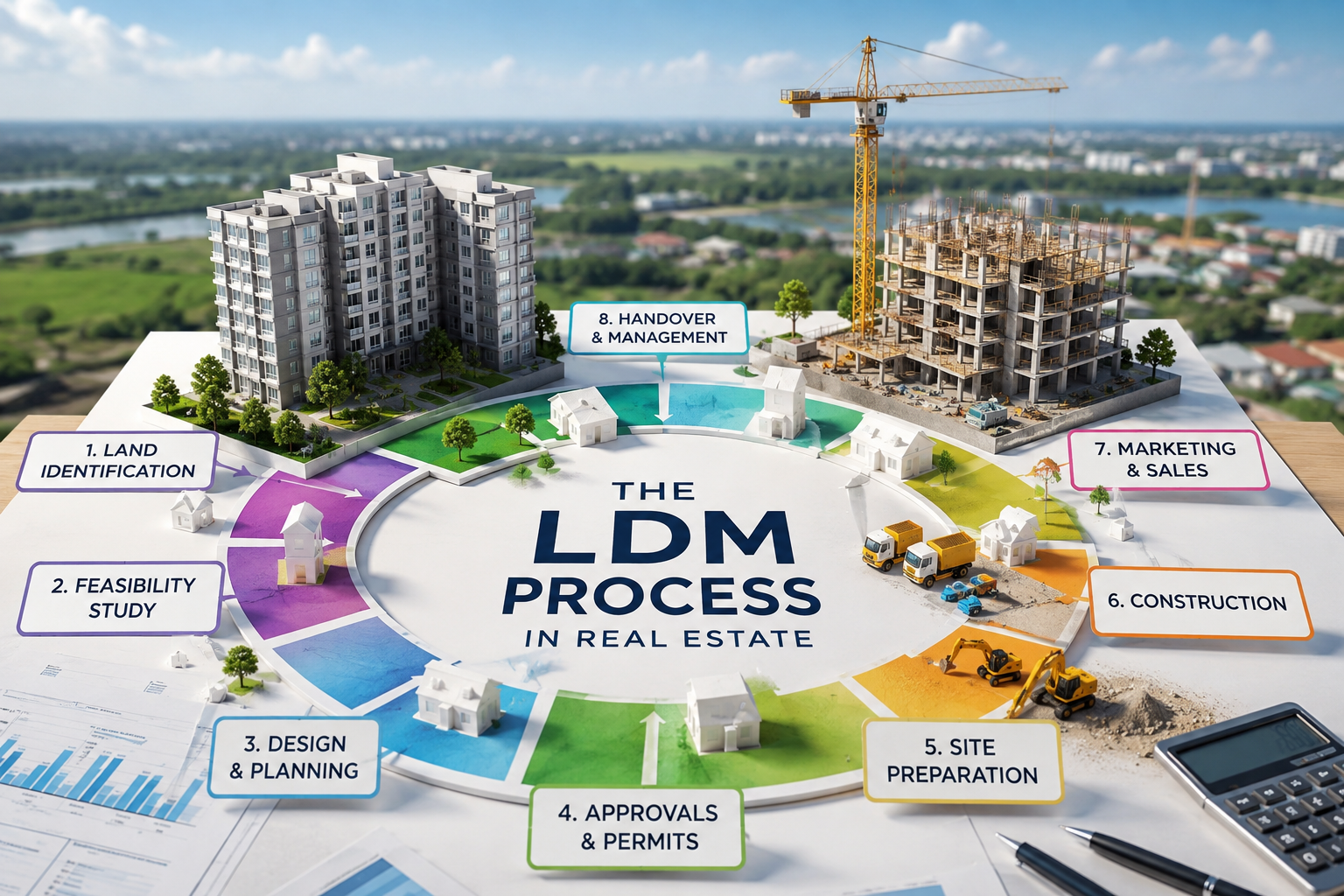
The LDM process in real estate can be understood as Land Development Management. It is the organised process used to take a piece of land from an early development idea to a completed property or building-ready site.
The process can include land research, financial feasibility, site studies, planning, zoning, design, government approvals, infrastructure work, construction, inspections, and final handover.
However, LDM is not a single universal legal term used in exactly the same way everywhere. Local authorities often describe the formal land-development process using stages such as zoning, subdivision, site planning, permitting, inspections, and occupancy approval. The exact requirements depend on the country, city, project, and type of land.
What Is the LDM Process in Real Estate?
In simple words, the LDM process is a way of managing the development of land from beginning to end.
Imagine a developer finds a large empty plot and wants to build homes on it. Construction cannot normally begin immediately.
The developer first needs to answer questions such as:
- Who owns the land?
- What can legally be built there?
- Is there enough demand for the project?
- Is the ground suitable for construction?
- Are roads, water, electricity, and drainage available?
- Will local authorities approve the project?
- How much will development cost?
- Can the completed project generate enough revenue?
Land Development Management brings these different tasks together so that the project can move forward in an organised way.
Quick Facts About the LDM Process
| Topic | Simple Explanation |
|---|---|
| LDM meaning used here | Land Development Management |
| Main purpose | Manage land development from idea to completion |
| First major step | Feasibility and due diligence |
| Important middle stages | Planning, zoning, design and permits |
| Development stage | Site preparation, infrastructure and construction |
| Final stages | Inspections, approvals, handover or sale |
| Main users | Developers, investors, planners, engineers and contractors |
| Main goal | Create a legally approved and financially workable development |
Why Is the LDM Process Important?
Real estate development involves much more than buying land and constructing buildings.
A property may appear attractive but still have serious problems. Its zoning may not allow the proposed development. Utilities may be expensive to connect. Environmental problems may exist. Access may be difficult, or construction costs may make the project financially unattractive.
The LDM process helps developers identify these problems before large amounts of money are committed.
Good land development management can help a project:
- control costs;
- identify risks early;
- meet planning requirements;
- coordinate engineers and contractors;
- avoid unnecessary delays;
- make better use of the land;
- understand possible project returns;
- prepare the property for sale, leasing, or occupation.
Stage 1: Site Selection
The first stage is choosing land that fits the planned project.
A developer may study several sites before selecting one.
Important factors can include:
- location;
- land price;
- nearby population;
- road access;
- public transport;
- utilities;
- surrounding development;
- local property demand;
- planning rules;
- environmental conditions.
The best-looking piece of land is not always the best development opportunity.
For example, cheaper land may become expensive if the developer must build major roads, drainage systems, or utility connections.
Stage 2: Feasibility Study and Due Diligence
Before making a major investment, the developer normally studies whether the project is realistic.
This is known as feasibility analysis and due diligence.
The team may investigate legal, physical, environmental, planning, market, and financial issues.
A typical review can examine:
Ownership and title
The developer needs to understand who owns the property and whether restrictions, liens, easements, or other legal issues affect it.
Zoning
Zoning rules can control how land may be used and what type of buildings may be constructed.
Market demand
The developer studies whether buyers or tenants are likely to want the finished homes, offices, shops, warehouses, or other property.
Physical condition
Engineers may study matters such as soil, slope, drainage, flooding, access, and utility connections.
Environmental risks
Environmental investigations can be especially important when land has previously been used for industrial or commercial purposes.
The U.S. Environmental Protection Agency, for example, describes environmental due diligence as a process for evaluating a property’s environmental condition, while broader property due diligence can examine zoning, liens, encroachments, and building conditions.
Requirements differ between countries, so professional local advice is important.
Stage 3: Financial Planning
A project may be physically possible but financially unsuccessful.
This is why developers prepare financial forecasts before moving ahead.
Possible costs include:
- land purchase price;
- professional fees;
- planning fees;
- taxes;
- financing;
- engineering;
- roads;
- drainage;
- utilities;
- landscaping;
- building construction;
- marketing;
- unexpected costs.
The expected income from selling or renting the finished property is then compared with the project’s costs and risks.
This stage helps investors decide whether development makes financial sense.
Stage 4: Concept Planning and Design
Once the site appears suitable, planners, architects, engineers, and developers can begin creating a more detailed plan.
For a housing project, the plan could show:
- streets;
- housing plots;
- homes;
- parking;
- drainage;
- parks;
- walking areas;
- utility routes.
Commercial projects may also include loading areas, access roads, parking spaces, retail units, offices, landscaping, and service areas.
Good design tries to balance the developer’s goals with engineering limits, planning rules, market needs, and community requirements.
Stage 5: Zoning and Development Approvals
Planning approval is one of the most important parts of land development.
Depending on the location and project, a developer may need permission for:
- rezoning;
- subdivision;
- land-use changes;
- site plans;
- road access;
- environmental work;
- utility connections;
- building construction.
Official development procedures can contain several separate approval stages.
For example, Virginia’s Department of Transportation describes its general land-development process as involving zoning, subdivision, site plans, and permitting. Prince William County lists additional steps including preliminary plans, final development plans, site permits, inspections, building permits, and certificates of occupancy.
These examples show why developers must check the rules applying to the actual location of their project.
Stage 6: Detailed Engineering
After the development concept becomes clearer, engineers prepare detailed plans.
These may cover:
- roads;
- foundations;
- grading;
- stormwater drainage;
- sewer systems;
- water supply;
- electricity;
- telecommunications;
- retaining structures;
- landscaping.
The engineering stage turns a general development idea into plans that contractors can actually build.
Stage 7: Permits
Before work begins, the project may require different permits.
The permits needed depend on the location and type of development.
Examples can include:
- building permits;
- land-disturbance permits;
- utility permits;
- road permits;
- environmental permits.
Authorities may require drawings, site plans, engineering calculations, surveys, and supporting documents before approving work.
Fairfax County’s development guidance, for example, explains that construction projects can require building, trade, and land-disturbance permits as well as reviews for compliance with zoning ordinances and construction codes.
Stage 8: Site Preparation
Once the required approvals are secured, physical work can start.
Site preparation can include:
- clearing vegetation;
- removing unwanted structures;
- grading land;
- managing soil;
- preparing access;
- installing drainage;
- preparing foundations.
The exact work depends heavily on the existing condition of the land.
Stage 9: Infrastructure Development
Infrastructure can be one of the biggest parts of a land-development project.
A developer may need to provide or improve:
- roads;
- sidewalks;
- water;
- sewer systems;
- electricity;
- street lighting;
- drainage;
- internet connections;
- public spaces.
For a large housing development, infrastructure may be completed in phases rather than all at once.
Stage 10: Construction
After the site is prepared and essential infrastructure is ready, construction of the main development can begin.
This could include:
- houses;
- apartment buildings;
- offices;
- warehouses;
- shops;
- hotels;
- mixed-use buildings.
Project managers normally monitor schedules, contractors, quality, safety, budgets, and changes throughout construction.
Stage 11: Inspections and Final Approvals
Completed work normally needs to be checked before buildings or sites can be fully used.
Depending on the jurisdiction, inspectors may examine:
- structural work;
- electrical systems;
- plumbing;
- fire safety;
- roads;
- drainage;
- utilities;
- accessibility;
- compliance with approved plans.
Some jurisdictions require a certificate of occupancy or similar final approval before a completed building can legally be occupied.
Official development procedures commonly place inspections and occupancy approval near the end of the development process.
Stage 12: Marketing, Sale, Leasing, or Handover
The final commercial stage depends on the developer’s strategy.
A developer might:
- sell completed homes;
- sell prepared building plots;
- lease commercial units;
- keep the property as a long-term investment;
- transfer completed infrastructure;
- hand the property to its new owner or operator.
Marketing often begins before construction is completely finished, especially on large projects.
Who Is Involved in the LDM Process?
Land development normally requires many specialists.
They may include:
- landowners;
- real estate developers;
- investors;
- lenders;
- architects;
- engineers;
- surveyors;
- environmental specialists;
- planning consultants;
- lawyers;
- local authorities;
- contractors;
- project managers;
- real estate agents.
One of the main purposes of development management is keeping these different parties working toward the same project goals.
Common Risks in the LDM Process
Planning delays
Development approvals can take longer than expected.
Unexpected site conditions
Poor soil, flooding, contamination, drainage problems, or underground infrastructure can change project costs.
Rising construction costs
Materials and labour can become more expensive during a long project.
Financing problems
Higher borrowing costs or changes in lender requirements can affect profitability.
Market changes
Property demand and prices can change before development is completed.
Infrastructure costs
Roads, drainage, water, sewer, and utility connections may cost more than originally estimated.
Design changes
Authorities, engineers, buyers, or site conditions can force changes to the original plan.
Good land development management tries to identify these risks early and create realistic budgets and backup plans.
Land Development Management vs Land Development Model
This distinction is important because LDM can mean different things in different real-estate contexts.
Land Development Management describes the broader coordination of a development project.
A Land Development Model, on the other hand, is usually a financial or feasibility model used to estimate costs, revenue, cash flow, land value, and investment returns.
Professional real-estate modelling resources use land development models to evaluate different development scenarios and forecast project economics.
Therefore, readers should always check how the term LDM is being used in the document, company, or market they are dealing with.
Simple Example of the LDM Process
Imagine a company wants to turn 20 acres of unused land into a residential community.
The process could look like this:
- The company finds suitable land.
- It studies ownership, zoning, demand, utilities, soil, and environmental risks.
- Financial analysts estimate development costs and possible revenue.
- Architects and planners design the community.
- Applications are submitted to local authorities.
- Engineers complete detailed road, drainage, and utility plans.
- Required permits are obtained.
- The site is cleared and prepared.
- Roads and utilities are installed.
- Homes are constructed.
- Authorities inspect the work.
- Completed homes are sold or transferred to buyers.
That is the basic idea behind Land Development Management.
How Long Does the LDM Process Take?
There is no universal timetable.
A small and simple project may move relatively quickly, while a large development can take years.
The timeline can be affected by:
- project size;
- zoning;
- environmental studies;
- public consultation;
- planning approvals;
- financing;
- engineering complexity;
- construction conditions;
- local regulations.
Developers should therefore avoid assuming that every development will follow the same schedule.
Frequently Asked Questions
What does LDM mean in real estate?
For the purpose of the term “LDM process in real estate,” LDM can be used to describe Land Development Management, meaning the organised management of land from early feasibility through planning, approvals, development, and completion.
However, LDM can also mean Land Development Model in financial analysis, so context is important.
What is the first step in the LDM process?
The first practical steps are usually site selection, feasibility analysis, and due diligence. Developers need to understand whether the land is legally, physically, and financially suitable.
Does LDM include zoning?
Yes. Zoning and land-use approval can be major parts of the development process because they help determine what may legally be built on a site.
Why is due diligence important?
Due diligence helps uncover problems involving ownership, planning, environmental conditions, physical limitations, access, and other risks before major investment decisions are made.
Does every real estate project follow the same LDM process?
No. The required stages vary by project and jurisdiction. A small residential project may have very different requirements from a large commercial or mixed-use development.
Who manages the LDM process?
A developer or development manager often coordinates the process with architects, engineers, planners, lawyers, contractors, lenders, consultants, and government agencies.
What is the most difficult part of land development?
There is no single answer. Planning approvals, financing, unexpected site conditions, infrastructure costs, and construction delays can all become major challenges.
Is LDM only for residential property?
No. Land-development management principles can apply to residential, commercial, industrial, mixed-use, and other development projects.
Final Thoughts
The LDM process in real estate provides a useful way to understand how land moves from an initial idea to a completed development.
It begins with research and feasibility, continues through design, zoning, approvals, engineering and permits, and then moves into site preparation, infrastructure, construction, inspections, and final handover or sale.
The most important thing to remember is that land development is not one simple action. It is a series of connected decisions involving money, land, law, planning, engineering, construction, and market demand.
A well-managed LDM process can help developers discover problems earlier, make better decisions, control risks, and create property that is both usable and financially sustainable.
