Introduction
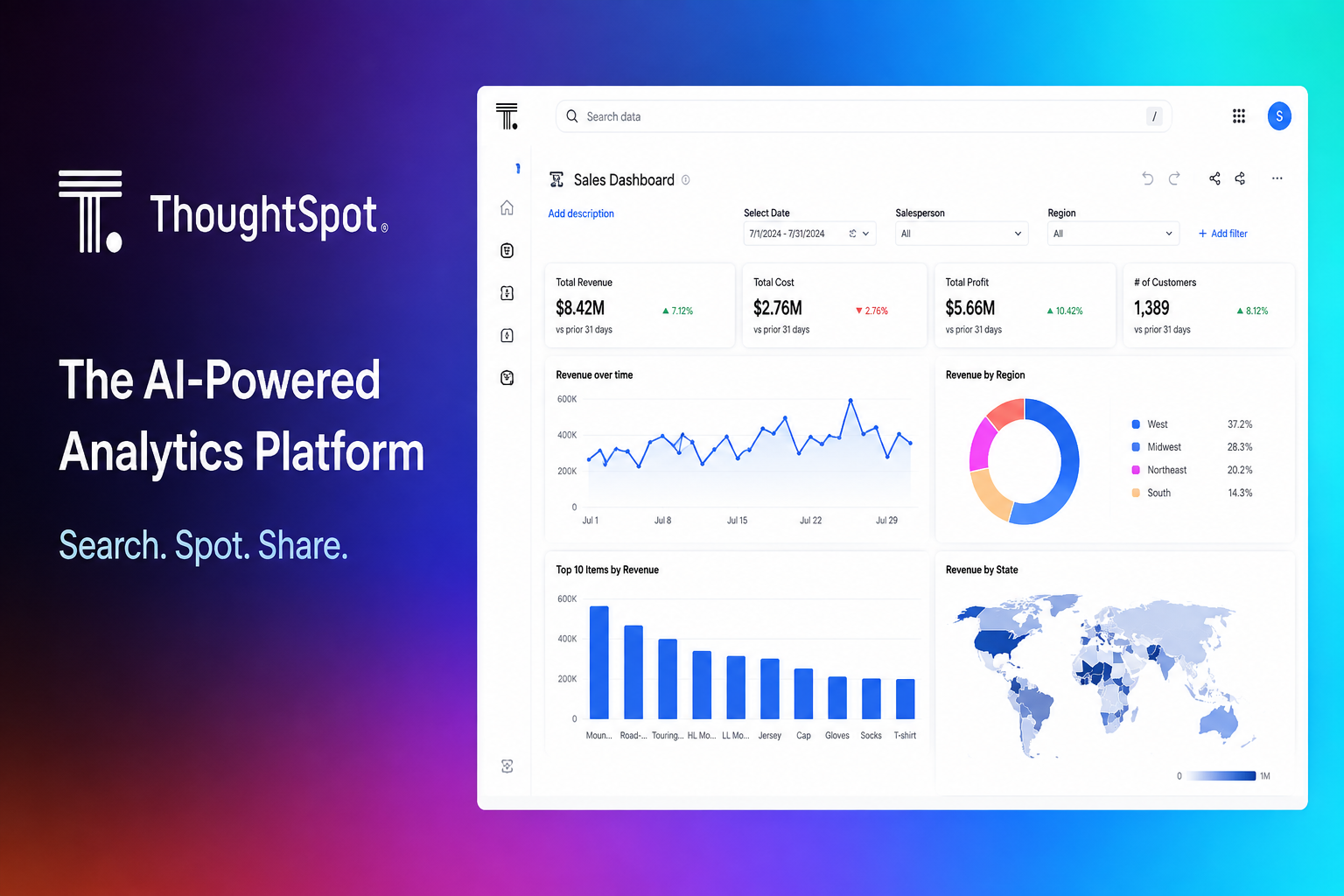
ThoughtSpot is an AI-powered business intelligence and analytics platform that helps people explore company data, ask questions in natural language, create interactive dashboards, and discover useful insights. Instead of depending only on traditional reports, users can ask questions about their data and receive answers through search and AI-powered analytics. ThoughtSpot currently describes its technology as an Agentic Analytics Platform.
The platform is mainly designed for businesses, analysts, data teams, product developers, and decision-makers who need to understand large amounts of business data without spending all their time building reports.
What Is ThoughtSpot?
ThoughtSpot is a business analytics platform that combines artificial intelligence, natural-language search, dashboards, automated insights, and data governance.
A user can ask a business question such as:
“What were our highest-selling products last month?”
Instead of manually creating a complicated report, ThoughtSpot can analyze connected company data and present relevant results.
The company says its goal is to make business data easier to access for people across an organization. Its platform includes enterprise analytics, embedded analytics, Analyst Studio, AI agents, automated insights, dashboards, and a semantic layer for managing business definitions.
How Does ThoughtSpot Work?
ThoughtSpot connects to an organization’s data environment and gives users different ways to explore that information.
One of its most important ideas is search-driven analytics. Instead of always writing SQL or asking a technical analyst to create a report, a business user can enter a question using normal language.
ThoughtSpot’s relational search technology can turn these questions into data queries and return visual or numerical answers. Its analytics platform also supports SQL, Python, and R for data professionals who need more advanced workflows.
This means ThoughtSpot attempts to serve two groups at the same time: everyday business users who want simple answers and professional data teams that need deeper analytical tools.
What Is Spotter in ThoughtSpot?
Spotter is ThoughtSpot’s AI analytics agent.
It allows users to communicate with business data through a conversational interface. ThoughtSpot says Spotter can reason through analytical questions and produce explainable answers based on governed enterprise data.
For example, a sales manager might ask why revenue dropped in a particular market. Instead of simply showing a chart, an AI analytics system can help investigate changes, patterns, and possible drivers in the underlying data.
ThoughtSpot introduced Spotter in November 2024 and has continued expanding its agent-based analytics capabilities since then.
Main Features of ThoughtSpot
ThoughtSpot combines several analytics technologies in one platform:
- Natural-language data search: Users can ask questions about business information using everyday language.
- Spotter AI Agent: An AI-powered analytical assistant designed to answer questions about enterprise data.
- Liveboards: Interactive dashboards connected to live data that allow users to drill into information.
- Automated insights: AI and machine learning can surface changes, anomalies, trends, and other useful information.
- Embedded analytics: Developers can place ThoughtSpot-powered analytics experiences inside their own products and applications.
- Analyst Studio: Data professionals can use SQL, Python, and R for more advanced analytical work.
- Semantic layer: Business definitions, calculations, security rules, joins, and other context can be governed before users ask questions.
- SpotIQ: ThoughtSpot’s augmented analytics technology can help discover anomalies and patterns across large datasets.
What Are ThoughtSpot Liveboards?
Liveboards are ThoughtSpot’s interactive approach to business dashboards.
Traditional dashboards can sometimes become fixed reports that people simply look at. ThoughtSpot Liveboards are designed to allow deeper exploration.
Users can move from a high-level business metric into more detailed information without always needing predefined drill paths.
ThoughtSpot says Liveboards can stay connected to live business data and combine interactive exploration with automated AI and machine-learning insights.
This can be useful for sales, finance, marketing, operations, customer service, and other departments where information changes frequently.
What Is ThoughtSpot Embedded?
ThoughtSpot Embedded is designed for companies that want to put analytics directly inside their own software.
For example, a software company may want its customers to see dashboards, search their data, or use AI analytics without leaving the company’s application.
Instead of developing every analytics feature from the beginning, developers can use ThoughtSpot’s APIs and SDKs to add analytics experiences to their products. ThoughtSpot currently promotes Embedded Analytics as one of the main parts of its platform.
What Is Spotter Semantics?
In March 2026, ThoughtSpot announced Spotter Semantics, an agentic semantic layer intended to give AI systems clearer business context.
A semantic layer helps define what company data actually means.
For example, different departments may calculate “active customer,” “revenue,” or “profit” differently. If an AI system does not understand those definitions, it may produce confusing results.
Spotter Semantics is designed to combine business definitions, security rules, metrics, calculations, and other context so that AI agents can interpret questions more consistently.
This is important because successful AI analytics depends not only on having powerful AI but also on having properly organized and governed business data.
Who Can Use ThoughtSpot?
ThoughtSpot is primarily aimed at organizations rather than ordinary consumers.
It can be useful for business leaders who want quick answers, sales teams tracking performance, finance teams reviewing numbers, analysts investigating trends, data leaders managing analytics systems, developers building analytics into applications, and organizations that want AI-assisted business intelligence.
ThoughtSpot specifically markets solutions for industries including financial services, retail and consumer goods, healthcare and life sciences, technology, supply chain, media, and telecommunications.
Benefits of ThoughtSpot
One important benefit is accessibility.
Business intelligence traditionally required specialized knowledge or help from data analysts. ThoughtSpot’s search and conversational interfaces are intended to reduce that barrier.
Another benefit is interactive exploration. A person does not necessarily need to stop after viewing a dashboard. They can investigate the numbers further.
AI-powered automated insights can also help users notice patterns they may not have searched for themselves.
For professional analysts, the availability of SQL, Python, R, data preparation, and advanced analytical workflows means the platform is not limited to simple business questions.
Possible Limitations of ThoughtSpot
ThoughtSpot can be powerful, but it will not automatically solve every data problem.
The quality of analytics still depends heavily on the quality and structure of the underlying business data. Poor definitions, incomplete data, incorrect permissions, or weak data governance can reduce the usefulness of any analytics system.
The platform is also designed heavily around business and enterprise analytics, so an individual looking for a simple personal spreadsheet or basic charting application may find it more advanced than necessary.
Organizations should therefore compare features, data requirements, integration needs, security requirements, and total costs before choosing an analytics platform.
ThoughtSpot Pricing
ThoughtSpot offers several pricing approaches.
As of August 2026, its official pricing page lists some user-based options starting at $25 per user per month when billed annually. An AI-focused user option is shown starting at $50 per user per month when billed annually.
ThoughtSpot also lists usage-based pricing starting at $0.10 per credit, while larger enterprise deployments use custom pricing. Certain developer options are also available.
Prices, limits, included AI queries, and plan features can change, so businesses should check the current ThoughtSpot pricing page before making a purchase decision.
Is ThoughtSpot an AI Tool?
Yes, but describing ThoughtSpot only as an AI tool would be incomplete.
It is primarily an analytics and business intelligence platform that now uses AI agents, natural-language interfaces, automated insights, machine learning, semantic modeling, and other technologies to help people understand business data.
Its current platform includes several AI-focused agents and capabilities, including Spotter and SpotterModel.
Is ThoughtSpot Like ChatGPT?
There are similarities in the conversational experience, but their main purposes are different.
A general AI chatbot can answer broad questions based on its available knowledge and tools.
ThoughtSpot is focused on analytics using an organization’s business data. Its AI experience is built around governed company information, metrics, dashboards, models, and analytical workflows.
In simple words, you might use a general chatbot to ask about a business topic, while you might use ThoughtSpot to ask what is happening inside your own company’s sales, customers, products, operations, or financial data.
ThoughtSpot vs Traditional Business Intelligence
Traditional business intelligence often revolves around analysts building reports and dashboards for other people.
ThoughtSpot tries to make analytics more interactive.
Instead of receiving a fixed report and stopping there, users can search, ask additional questions, drill into metrics, receive AI-generated insights, and explore changing business information.
This does not mean dashboards are disappearing. ThoughtSpot itself still offers dashboards through Liveboards. The difference is that dashboards are combined with search, AI agents, automated analysis, and deeper exploration.
Is ThoughtSpot Worth Using?
ThoughtSpot may be worth considering for organizations that have large amounts of business data and want more employees to explore that data without depending on a small analytics team for every question.
It may be especially useful when a business needs natural-language analytics, interactive dashboards, embedded analytics, governed metrics, AI-assisted investigation, or advanced analysis from one platform.
However, the best analytics platform depends on the company’s existing technology, data warehouse, team skills, budget, security requirements, and business goals.
Who Founded ThoughtSpot?
ThoughtSpot says it was created to solve a simple problem: making data accessible to everyone who needs it.
Its official leadership information identifies Ajeet Singh as co-founder and Executive Chairman and Amit Prakash as a co-founder.
The company’s main headquarters is currently listed in Mountain View, California.
Frequently Asked Questions About ThoughtSpot
What is ThoughtSpot used for?
ThoughtSpot is used to analyze business data, search for answers using natural language, create interactive dashboards, discover automated insights, and embed analytics inside other applications.
Is ThoughtSpot free?
ThoughtSpot currently offers certain free or trial/developer options, while its commercial analytics plans include paid per-user, usage-based, and custom enterprise pricing.
Does ThoughtSpot use artificial intelligence?
Yes. ThoughtSpot combines AI agents, natural-language processing, machine learning, automated insights, search technology, and governed analytics.
What is Spotter AI?
Spotter is ThoughtSpot’s AI analytics agent. It allows users to ask conversational questions about enterprise data and receive analytical answers.
Does ThoughtSpot require coding?
Basic business users can use search and conversational interfaces without writing code. Advanced analysts can also work with SQL, Python, and R through ThoughtSpot’s analytical tools.
Can ThoughtSpot create dashboards?
Yes. ThoughtSpot provides interactive dashboards known as Liveboards, which can stay connected to live data and support deeper exploration.
Can ThoughtSpot be embedded into another application?
Yes. ThoughtSpot Embedded allows developers and software companies to integrate AI-powered analytics, dashboards, and related experiences into their own applications.
Is ThoughtSpot only for large companies?
ThoughtSpot has strong enterprise capabilities, but its official pricing and product pages also show options designed for smaller teams, developers, and startups.
Final Thoughts
ThoughtSpot represents a newer approach to business intelligence where users do more than simply look at charts.
Its combination of natural-language search, Spotter AI, Liveboards, automated insights, embedded analytics, analytical coding tools, and governed business context is designed to help organizations move from data to decisions more quickly.
The most important idea is simple: people should be able to ask business questions in language they understand and receive useful answers from trusted company data.
As AI becomes more deeply connected with business intelligence, ThoughtSpot is positioning its platform around this combination of AI agents, enterprise data, analytics, governance, and human decision-making.
