Introduction
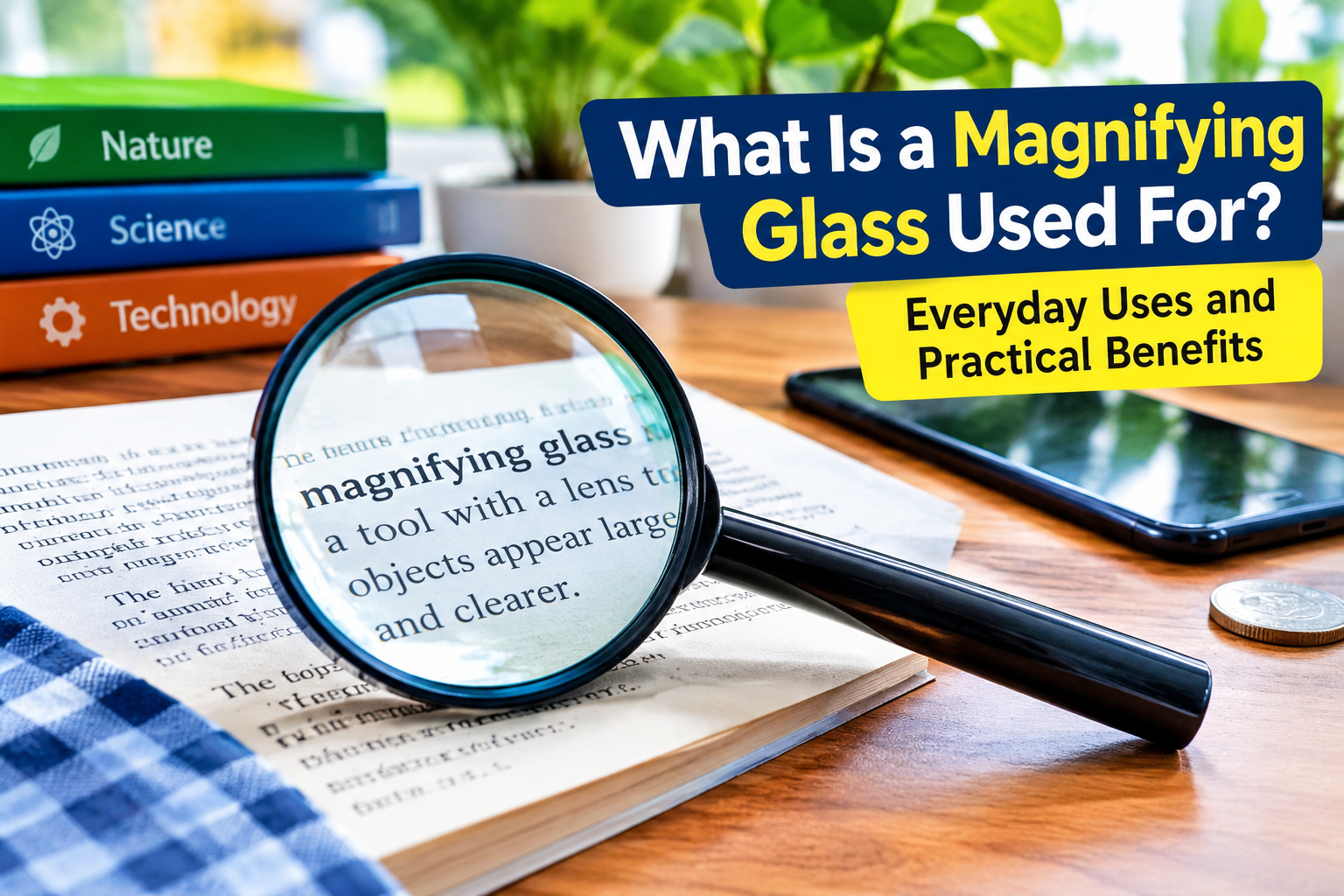
A magnifying glass is a simple optical tool that makes small nearby objects, text, and details appear larger and easier to examine. It is commonly used for reading fine print, inspecting small objects, hobbies, crafts, education, and close-up visual work. A traditional magnifying glass uses a convex lens to create an enlarged virtual image when an object is positioned within the lens’s focal length.
What Is a Magnifying Glass?
A magnifying glass is an optical device consisting mainly of a convex lens mounted in a frame, often with a handle. The curved lens bends light so that nearby details appear larger to the viewer.
Unlike a microscope, a basic magnifying glass uses a single lens. Its simplicity makes it inexpensive, portable, and useful for quick visual inspections.
How Does a Magnifying Glass Work?
The main component is a convex lens, which is thicker in the middle than at the edges. When an object is placed closer to the lens than its focal length, the lens produces an upright, enlarged virtual image. This makes the object appear bigger without physically changing its size.
The amount of magnification depends on the lens and how it is positioned. Higher magnification can provide more detail, but it generally comes with a smaller viewing area and shorter working distance.
Reading Small Print
One of the most familiar uses of a magnifying glass is reading small text. It can help with labels, instructions, maps, menus, printed numbers, and other details that are difficult to see clearly.
An illuminated magnifying glass can be particularly useful because additional light can make tiny text easier to distinguish.
Examining Coins and Stamps
Collectors often use magnifying glasses to inspect coins, stamps, and other collectibles. Magnification can reveal small lettering, patterns, printing details, surface marks, and other features that may not be obvious to the naked eye.
For collectors, the tool provides a convenient way to perform a quick close-up examination.
Jewelry Inspection
A magnifying glass can help examine jewelry and gemstones at close range. Small settings, decorative patterns, engravings, and surface details can become easier to see.
Professional jewelry inspection may use specialized optical equipment, but a simple magnifier can still be useful for basic visual checking.
Crafts and Needlework
Magnifying glasses are useful for hobbies that involve small details. Sewing, embroidery, model making, miniature painting, and other crafts can involve tiny components or patterns.
A hands-free stand magnifier can be particularly convenient when both hands are needed for the activity.
Studying Plants and Insects
Students, teachers, gardeners, and nature enthusiasts can use magnifying glasses to examine leaves, flowers, insects, bark, soil particles, and other small natural features.
A magnifier cannot replace a microscope for very small structures, but it can provide a quick way to observe textures and visible details.
Educational Science Activities
Magnifying glasses are also useful educational tools. They allow students to explore basic concepts involving lenses, light, refraction, observation, and magnification.
Because the optical principle is relatively simple, a magnifying glass is often used when introducing students to basic optics.
Inspecting Small Mechanical Parts
Small screws, components, markings, and mechanical parts can sometimes be difficult to inspect with the naked eye. A magnifying glass provides a quick enlarged view.
It can therefore be useful for hobbies involving model building, small mechanisms, and detailed assembly work.
Electronics and Circuit Inspection
Magnification can help users visually examine small electronic components, connections, markings, and circuit-board features.
For professional electronics work, specialized inspection equipment may be more appropriate, but a basic magnifier can be useful for simple visual checks.
Artwork and Fine Details
Artists, collectors, and hobbyists may use magnifying glasses to inspect fine lines, textures, printed details, or small imperfections in artwork and decorative objects.
The ability to focus attention on a small area makes the tool useful when ordinary viewing does not provide enough detail.
Maps, Labels, and Small Markings
Magnifying glasses can make tiny numbers and markings easier to read on maps, labels, measuring instruments, packaging, and other printed materials.
This is particularly useful when information is printed in a very small font or when the user needs to inspect one specific area rather than an entire page.
Magnifying Glasses and Low-Vision Tasks
Magnifying lenses can also assist with certain close-up activities for people with low vision. Different magnification devices are available depending on the task, including handheld and stand magnifiers.
However, a magnifying glass is not a replacement for professional eye care. Persistent changes in vision should be discussed with an eye-care professional.
What Are the Main Benefits?
The practical benefits of a magnifying glass include:
- Simple operation: No complicated controls are usually required.
- Portable design: Handheld models can be carried easily.
- Immediate enlargement: Small details become easier to inspect.
- Versatility: One tool can serve reading, hobbies, education, and inspection.
- Low maintenance: Traditional models do not require batteries.
- Affordable access to magnification: Basic models are widely available.
Choosing the Right Magnifying Glass
The best type depends on the task. For occasional reading, a handheld model may be sufficient. For crafts or detailed work requiring both hands, a stand or hands-free magnifier can be more convenient.
Consider the magnification level, lens size, lighting, working distance, weight, and comfort before choosing one. Very high magnification is not automatically better because stronger magnification can reduce the field of view and make positioning more sensitive.
Important Safety Considerations
A magnifying glass should never be used to look directly at the Sun. A convex lens can concentrate sunlight and create an intense focal point that can cause serious eye injury or start a fire.
For ordinary close-up viewing, use the magnifier as intended and keep the lens clean and free from scratches when possible.
Conclusion
A magnifying glass may be a simple device, but it has many practical applications. From reading fine print and examining collectibles to studying nature, completing crafts, and inspecting small components, its main purpose is to make nearby details easier to see.
Its effectiveness comes from a basic optical principle: a convex lens can produce an enlarged virtual image when the object is positioned appropriately.
For everyday close-up tasks, that combination of simplicity, portability, and useful magnification makes the magnifying glass a remarkably practical tool.
