Introduction
A car accident can happen within seconds, but proving who was responsible may take considerably longer. When a collision causes injuries, vehicle damage, or financial losses, establishing negligence usually requires more than simply saying another driver was at fault. The evidence should connect the driver’s conduct to the accident and the resulting losses.
In a typical negligence claim, the main issues include whether the other person owed a duty of care, breached that duty, caused the accident or injury, and caused legally recognizable damages. These are commonly described as the core elements of negligence.
What Is Negligence in a Car Accident?
Negligence generally means failing to exercise the level of reasonable care expected in the circumstances. On the road, drivers have responsibilities to operate their vehicles with appropriate care and avoid conduct that creates an unreasonable risk to other road users.
Examples can include distracted driving, unsafe overtaking, failing to yield, ignoring traffic signals, dangerous lane changes, or driving in a manner that is inappropriate for road and traffic conditions.
However, an accident by itself does not always establish every element of a negligence claim. The available evidence must be considered to determine what happened and whether the driver’s conduct legally caused the injury or loss.
The Four Main Elements You May Need to Prove
1. Duty of Care
The first issue is generally whether the other driver owed you a duty of care. Drivers are ordinarily expected to operate their vehicles reasonably and safely around other road users.
The exact legal definition can vary according to jurisdiction and circumstances.
2. Breach of Duty
Next, you generally need to show that the driver’s conduct fell below the required standard of care.
For example, evidence might show that a driver:
- Failed to stop at a traffic signal
- Changed lanes without adequate care
- Followed another vehicle too closely
- Drove while distracted
- Failed to yield where required
- Made an unsafe turn
- Drove carelessly in difficult road conditions
The important question is not simply whether an accident happened, but what the driver did or failed to do before the collision.
3. Causation
Causation connects the alleged negligent conduct to the accident and resulting injury or loss.
For example, if a driver ignored a traffic signal and collided with another vehicle, photographs, witness accounts, video footage, and other evidence may help establish the connection between the conduct and the collision.
Courts may examine whether the injury would have occurred without the alleged negligent conduct and whether there was another event that interrupted the causal connection.
4. Damages
Finally, there generally must be actual harm or loss.
Depending on the circumstances and applicable law, damages can involve:
- Medical expenses
- Property or vehicle damage
- Lost income
- Rehabilitation expenses
- Other documented financial losses
- Compensation for legally recognized injuries
Keeping organized records can make it easier to demonstrate the extent of the loss.
Collect Evidence at the Accident Scene
Evidence from the accident scene can be particularly important because vehicles, road positions, debris, traffic conditions, and other physical circumstances can change quickly.
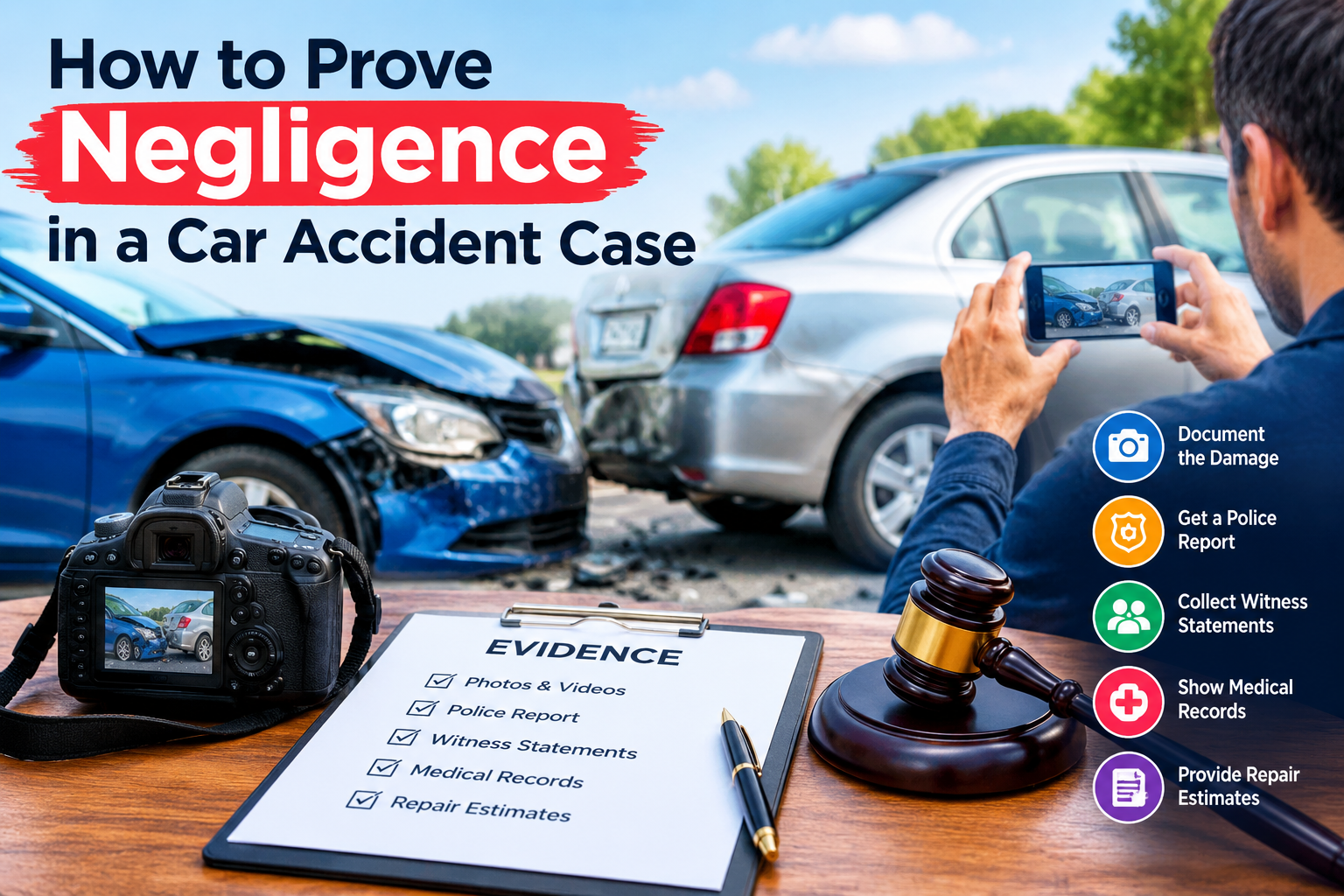
If it is safe to do so, photographs can document the vehicles, damage, road layout, traffic signs, lane markings, weather conditions, and surrounding area.
Police or accident-investigation records may also contain information about the location, parties, witnesses, photographs, diagrams, alleged traffic violations, and other circumstances of the collision.
Safety should always come first. Do not put yourself or another person at risk merely to obtain photographs.
Find and Preserve Witness Information
People who saw the accident may provide useful independent accounts of what happened.
If witnesses are present and it is safe and appropriate to do so, record their names and contact information. In some jurisdictions, witness testimony can help establish issues such as vehicle movements, traffic signals, speed, lane position, or what happened immediately before the collision.
Independent witnesses may be particularly useful because they may have no direct financial interest in the outcome.
Look for Video and Digital Evidence
Modern accidents may leave behind several forms of digital evidence.
Depending on the location, potentially relevant material can include:
- Dashcam recordings
- Traffic-camera footage
- Security-camera recordings
- Mobile-phone video
- Photographs taken shortly before or after the crash
Some recordings may be automatically overwritten after a limited period. If potentially relevant footage exists, identifying and preserving it promptly can therefore be important.
Obtain Relevant Police and Medical Records
Official records can help establish the sequence of events and the consequences of an accident.
Medical records can document the nature of injuries, treatment, follow-up appointments, and medical expenses. Police or accident reports may document information gathered at the scene.
In Pakistan, official police and court materials recognize the importance of documentary and oral evidence in negligence-related claims. The Sindh High Court has discussed evidence concerning eyewitnesses, causation, and negligent driving in accident cases.
Document Vehicle and Property Damage
Take photographs of visible damage to all relevant vehicles and keep repair estimates, invoices, inspection reports, and other supporting documents.
The pattern and location of vehicle damage may also help investigators reconstruct how a collision occurred. However, photographs and physical evidence should be interpreted together with witness accounts, road conditions, traffic information, and other available evidence rather than treated as conclusive by themselves.
Keep a Record of Your Injuries and Losses
After an accident, keep copies of medical documents, prescriptions, invoices, transportation expenses, repair bills, and other records related to the incident.
A clear timeline can also be useful. Record important dates such as the accident date, medical appointments, diagnostic examinations, repair inspections, and other accident-related events.
Objective documentation can help demonstrate both the existence and extent of losses.
Be Careful When Describing What Happened
When speaking with police officers, insurers, witnesses, or legal representatives, focus on accurate facts.
Avoid guessing about details you do not remember. For example, if you are uncertain about the exact speed of another vehicle, it is better to say that you are uncertain than to provide an unsupported estimate.
Photographs, video, witnesses, official records, and physical evidence can help establish facts that are difficult to remember after a stressful collision.
Understand That Liability Can Be Disputed
The other driver or an insurer may disagree about who caused the accident. There may also be disputes concerning whether another factor contributed to the collision or whether the claimed injuries and losses were caused by the accident.
In some cases, more than one person may have contributed to an accident. The legal consequences of shared responsibility vary by jurisdiction.
For example, Sindh High Court decisions have discussed situations involving multiple negligent parties and the relationship between negligence, causation, and resulting loss.
Organize Your Evidence
A simple accident file can make the information easier to understand.
Consider keeping:
- Police or accident reports
- Photographs and videos
- Witness information
- Medical records and bills
- Vehicle repair documents
- Insurance correspondence
- Receipts for accident-related expenses
- A written timeline of events
- Relevant messages or communications
- Any available camera or dashcam footage
Keep original files where possible and make backup copies of important digital evidence.
When Professional Legal Advice May Help
A straightforward insurance claim may sometimes be handled through the relevant insurer, but complicated cases can involve disputed liability, serious injuries, multiple vehicles, substantial losses, or disagreements about evidence.
A qualified lawyer in the relevant jurisdiction can explain the applicable rules, evidence requirements, filing deadlines, and available legal remedies.
Because negligence law differs between countries and even between regions within a country, general online information should not be treated as a substitute for advice about a specific accident.
Final Thoughts
Proving negligence in a car accident case is primarily about establishing a clear connection between the driver’s conduct, the collision, and the resulting harm. Strong evidence can include photographs, eyewitness accounts, official reports, video footage, medical documentation, and records of financial losses.
The most useful approach is to preserve evidence early, keep accurate records, and avoid relying on a single piece of evidence to establish the entire case. In a civil negligence claim, the precise burden and standard of proof depend on the applicable law and type of proceeding.
