Introduction
AI coding assistants have changed how software teams write, test, and maintain applications. Developers can now generate functions, tests, database queries, documentation, and entire features with the help of AI. This can speed up development, but generated code should never be treated as automatically production-ready.
AI-generated code can contain incorrect logic, insecure patterns, unnecessary dependencies, hallucinated APIs, weak tests, or assumptions that do not match the application. GitHub recommends combining automated checks with human review, while OWASP emphasizes that developers remain accountable for AI-assisted code that is accepted and shipped.
A structured review process can help teams catch problems before they become production incidents.
What Makes AI-Generated Code Different?
Traditional code is normally written with a developer’s understanding of the project’s requirements and architecture. AI-generated code is produced from prompts and available context, which means it may confidently make assumptions that are incorrect.
Common issues include:
- Incorrect business logic
- Hallucinated functions or APIs
- Missing edge cases
- Insecure input handling
- Poor error handling
- Unnecessary dependencies
- Weak or misleading tests
- Outdated implementation patterns
- Code that does not follow project conventions
For this reason, passing tests alone is not enough. The code must also be understood and evaluated by people who know the application’s requirements and architecture.
Start With the Requirements
Before reviewing individual lines, confirm what the change is supposed to accomplish.
Read the issue, feature specification, acceptance criteria, or technical design. Then compare those requirements with the generated implementation.
Ask:
- Does the code solve the intended problem?
- Does it handle the expected user flows?
- Does it follow the existing architecture?
- Does it preserve existing behavior?
- Are there assumptions that were never part of the requirements?
GitHub recommends checking AI-generated code against the project’s requirements, architecture, documentation, and established design patterns.
A technically elegant implementation can still be wrong if it solves the wrong problem.
Run Automated Tests and Static Analysis
The next step should be automated validation.
Run the project’s normal checks before approving the change:
- Unit tests
- Integration tests
- End-to-end tests
- Linters
- Type checking
- Static analysis
- Dependency scanning
- Security scanning
- Code coverage checks
GitHub specifically recommends running automated tests and static analysis when reviewing AI-generated code. Tools such as CodeQL and dependency scanning can help identify security and dependency problems.
However, automated tools should support human review rather than replace it.
Review the Code Line by Line
Once automated checks pass, inspect the implementation itself.
Look at:
Readability
Can another developer understand the code without relying on the original AI prompt?
Naming
Do functions, variables, classes, and parameters clearly communicate their purpose?
Complexity
Has AI introduced unnecessary abstractions, deeply nested conditions, or complicated logic for a simple task?
Error Handling
Does the code handle expected failures properly?
Maintainability
Would another developer be able to modify the implementation safely six months from now?
Google’s code-review guidance emphasizes understanding the code being reviewed rather than assuming that code is correct simply because it looks reasonable.
Check Security Carefully
Security deserves additional attention because AI-generated code can produce implementations that appear reasonable while missing important security controls.
Review:
- Authentication
- Authorization
- Input validation
- Output encoding
- Session handling
- Secrets management
- File handling
- Database queries
- API permissions
- Error messages
- Logging
- Cryptographic operations
OWASP describes manual secure code review as an important complement to automated security testing because human reviewers can examine business logic, data flow, and context-specific vulnerabilities that automated tools may miss.
Security-sensitive changes may deserve an additional reviewer or specialized security review.
Examine Dependencies Before Approval
AI coding tools may recommend libraries or packages that developers have not previously used.
Do not automatically install them.
Check:
- Does the package actually exist?
- Is it maintained?
- Is the source trustworthy?
- Does it have an appropriate license?
- Is the selected version suitable?
- Does the project really need the dependency?
- Are there known security concerns?
GitHub specifically warns reviewers to watch for hallucinated or suspicious packages and to verify dependencies rather than blindly accepting AI suggestions.
Unnecessary dependencies increase maintenance and security risk, so simpler solutions should be considered when appropriate.
Test Edge Cases, Not Just Happy Paths
AI-generated tests may concentrate on normal scenarios while missing unusual or adversarial inputs.
Create additional tests for situations such as:
- Empty input
- Invalid input
- Extremely large input
- Missing values
- Duplicate requests
- Expired credentials
- Unexpected API responses
- Boundary values
- Concurrent operations
- Permission failures
OWASP’s current AI secure-coding guidance specifically warns that generated tests can give false confidence if they merely reproduce the generated implementation’s assumptions. It recommends independent negative and adversarial testing, particularly for security-sensitive functionality.
Watch for Modified or Deleted Tests
One particularly important review step is checking what happened to existing tests.
An AI tool may modify a failing test instead of correcting the underlying implementation. A test may also become weaker while still passing.
Look for:
- Deleted tests
- Reduced assertions
- New excessive mocking
- Changed expected results
- Tests that simply confirm the implementation
- Missing negative cases
A green CI pipeline does not automatically prove that the implementation is correct. The tests themselves need human evaluation.
Review AI-Specific Mistakes
AI-generated code has several distinctive failure patterns.
Hallucinated APIs
The code may call a function, parameter, endpoint, or library feature that does not actually exist.
Incorrect Assumptions
The model may assume a particular database structure, framework version, or application behavior.
Ignored Constraints
The generated implementation may overlook performance, compatibility, privacy, or architectural requirements.
Overengineering
AI can produce significantly more code than necessary.
Confidently Wrong Logic
Perhaps the most important risk is code that looks professional but implements the wrong behavior.
GitHub recommends specifically looking for hallucinated APIs, ignored constraints, incorrect logic, and tests that have been removed or weakened.
Use AI as a Reviewer, Not the Final Authority
AI can also help review AI-generated code. For example, developers can ask an AI tool to identify possible edge cases, security concerns, missing tests, or maintainability problems.
But an AI review should be treated as another review layer, not final approval.
GitHub supports AI-assisted code review while still emphasizing human oversight. OWASP likewise states that AI-generated code requires human accountability and should not bypass human review.
A useful workflow is:
AI generates → automated checks → AI-assisted review → human review → security review when needed → CI → production
Establish a Human Approval Process
Every production-bound AI-generated change should have a clearly responsible human owner.
The reviewer should understand:
- What changed
- Why it changed
- What requirements it satisfies
- What tests were performed
- What security risks were considered
- Which dependencies were introduced
- What limitations remain
OWASP’s AI security guidance emphasizes human accountability for AI-generated code and recommends explicit developer approval before merging.
For particularly sensitive areas such as authentication, authorization, and cryptography, organizations may choose stronger review requirements.
Automate the Production Gate
A strong review process should not depend entirely on individual memory.
CI/CD pipelines can automatically enforce:
- Build success
- Unit and integration tests
- Linting
- Static analysis
- Dependency scanning
- Secret scanning
- Security checks
- Code coverage requirements
OWASP’s AI secure-coding guidance also recommends automated security testing for pull requests containing AI-generated code.
Critical findings should prevent deployment until they are fixed or formally reviewed according to the organization’s process.
Protect Sensitive Project Information
AI coding tools may receive code, project structure, terminal output, or other development context.
Before using an AI coding assistant, understand what information the tool can access and how that information is handled. Sensitive credentials, private keys, personal information, and confidential business data should receive particular attention.
OWASP recommends reviewing the context sent to AI coding systems and configuring tools to exclude sensitive directories where appropriate.
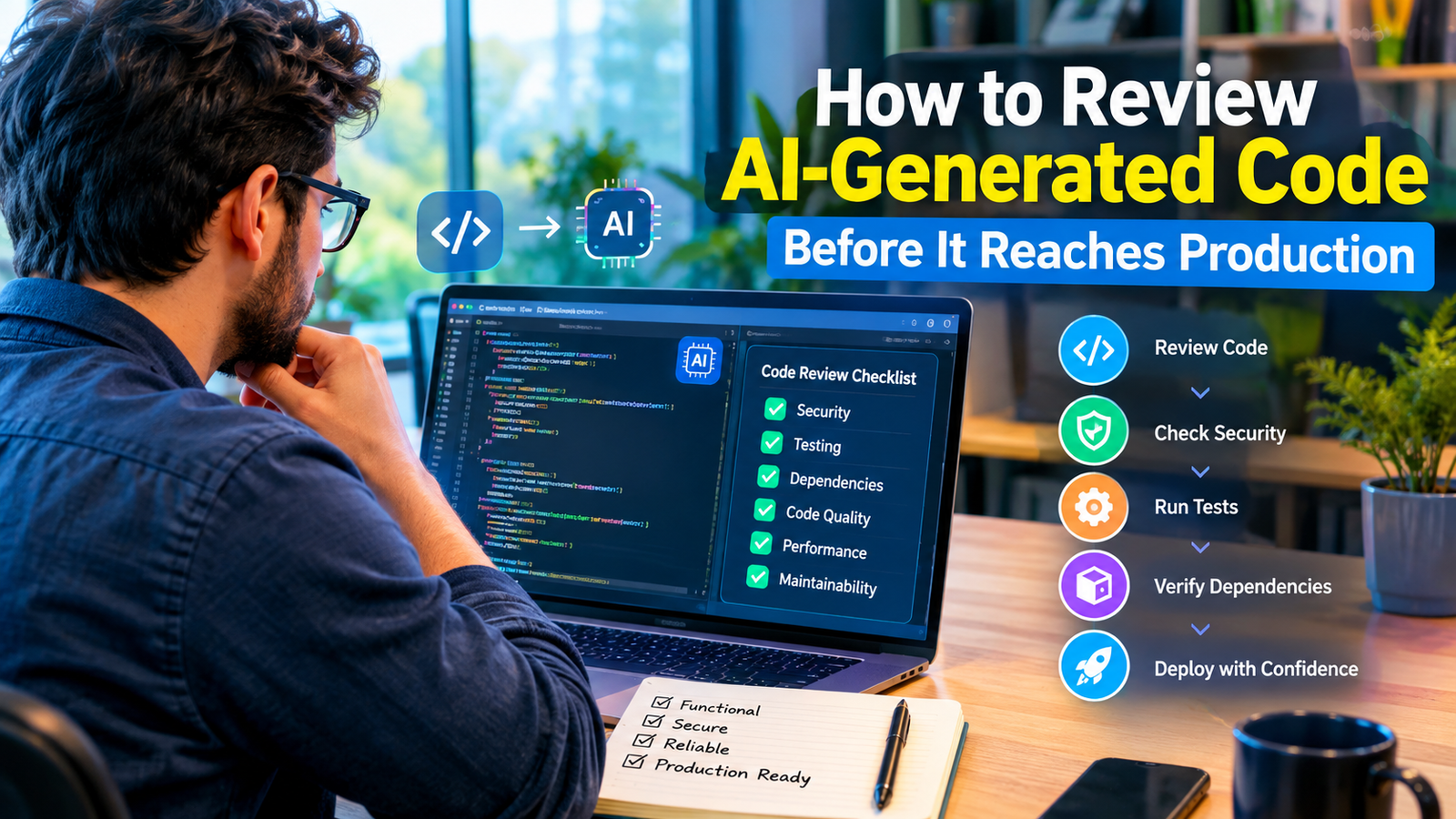
A Practical Pre-Production Checklist
Before AI-generated code reaches production, review the following:
- Requirements are clearly understood
- Code solves the intended problem
- Existing behavior has been considered
- Automated tests pass
- New tests cover important scenarios
- Edge cases have been tested
- Existing tests were not weakened unnecessarily
- Static analysis has passed
- Security scanning has passed
- Dependencies have been verified
- Secrets are not exposed
- Authentication and authorization are correct
- Error handling is appropriate
- Code is readable and maintainable
- Performance implications have been considered
- A qualified human has reviewed the change
- Security-sensitive changes receive appropriate additional review
- CI/CD production gates have passed
Conclusion
AI-generated code can accelerate software development, but speed should not remove engineering discipline. The safest approach is to treat generated code as a proposed implementation that still needs testing, security analysis, architectural review, and human approval.
The most effective workflow combines automated testing, static and security analysis, dependency verification, edge-case testing, AI-assisted review, and qualified human judgment. GitHub and OWASP both emphasize that human oversight remains an important part of validating AI-generated software.
Before production deployment, the key question is not whether AI produced the code. It is whether the team has demonstrated that the code is correct, secure, maintainable, and appropriate for the system it will run in.
